Four Extremes That No Other Track Drive Faces Simultaneously
A feller buncher operates on steep slopes — but in warm to temperate climates. A pipeline tractor works in Arctic cold — but on flat terrain. A snow groomer combines the worst of both environments and adds two more challenges that no other machine encounters. The 履带驱动行星齿轮箱 must survive all four simultaneously.
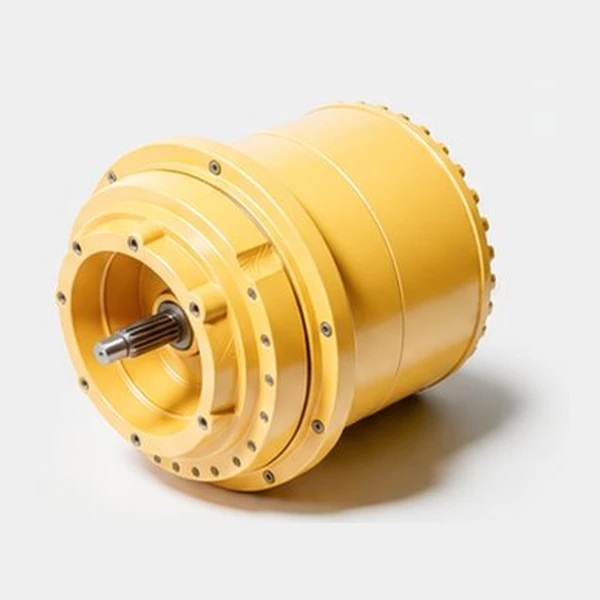
Standard 80W-90 gear oil at -40 degrees C has the viscosity of cold honey — 50,000 to 100,000 cSt versus the 150 to 300 cSt operating range. At cold start, the oil does not flow to the planet bearings. The gears churn through semi-solid lubricant, generating heat locally while the rest of the oil bath remains frozen. The first 10 to 15 minutes of operation are the most damaging of the entire shift.
Expert ski runs reach 35 to 45 degrees — steeper than any feller buncher operates (30 to 40 degrees). On slopes above 35 degrees, the groomer is winch-assisted: a steel cable connects the machine to a drum at the summit, and the winch supplements the track drive torque during climbing. But the track drive still carries 50 to 70% of the climbing force even with winch assist.
Snow groomer tracks are 3.5 to 4.5 metres total width — 3 to 4 times wider than an excavator. The extreme width distributes the 10 to 14 tonne machine weight to achieve 3 to 6 kPa ground pressure — the lowest of any production tracked vehicle. Each track drive must transmit torque to a sprocket that engages a rubber-and-steel track belt of unprecedented width.
Grooming begins when the lifts close (typically 17:00) and must finish before first lift (08:00). The track drives operate for 10 to 12 hours continuously, through the coldest hours of the night (02:00 to 05:00), on every grooming day of the season — 120 to 150 nights per year. There is no daytime warm-up period and no mid-shift maintenance window.
Cold-Start Damage — The 15 Minutes That Determine Track Drive Service Life
At -30 to -40 degrees C, standard gear oil does not behave as a liquid. It behaves as a semi-solid paste. When the operator starts the groomer and engages the track drives, the planetary gears must rotate through this paste — and the planet pin bearings receive no oil flow until the churning generates enough local heat to thin the oil in the immediate vicinity of each bearing. This cold-start phase lasts 10 to 15 minutes and produces more bearing surface damage than the remaining 10 hours of the shift combined.
| 温度 | Oil Viscosity (80W-90) | Oil Viscosity (75W-80 Synthetic) | Bearing Condition |
|---|---|---|---|
| +20°C (reference) | 180 cSt | 120 cSt | Full hydrodynamic film |
| -10°C | 5,000 cSt | 1,200 cSt | Marginal flow |
| -25°C | 25,000 cSt | 4,000 cSt | Boundary lubrication |
| -40°C | 80,000+ cSt (semi-solid) | 12,000 cSt | Dry running / channelling |
At -40 degrees C, standard 80W-90 mineral oil is 80,000+ cSt — effectively solid. The gears channel through it without distributing it to the bearings. Fully synthetic 75W-80 at -40 degrees C is 12,000 cSt — still very thick, but fluid enough to be displaced by gear rotation and reach the planet bearings within 5 to 8 minutes (vs 15+ minutes with mineral oil). This 7-minute difference in cold-start bearing-oil delivery is the difference between acceptable and accelerated bearing wear over a 150-night season.
Best practice for snow groomer cold starts below -20 degrees C: start the engine and run the track drives at zero load (tracks lifted or machine on flat ground) for 5 minutes before applying load. This allows the gear churning to warm the oil locally without the bearing stress of full-torque climbing. Resorts that enforce this protocol report 30 to 40% longer track drive service life compared to operators who engage full climbing torque immediately from cold.
Winch-Assisted Slope Climbing — How the Track Drive and Winch Share the Load on Expert Terrain
On slopes up to 25 to 30 degrees, the snow groomer climbs under track drive power alone — the track-to-snow friction is sufficient to propel the machine uphill. Above 30 degrees, the friction limit is approached and the tracks begin to slip. On expert-level ski terrain at 35 to 45 degrees, a steel winch cable connects the groomer to a drum anchored at the summit and supplements the track drive climbing force.
Even with winch assist, the track drives carry the majority of the climbing force. The winch supplements — it does not replace — the track propulsion. If the track drive stalls on a winch-assisted climb, the machine hangs on the cable without forward progress. The track drive must maintain continuous output torque at 50 to 70% of the total climbing requirement throughout the ascent — typically 3 to 10 minutes per run on a 300 to 800 metre slope.
On the downhill pass, the winch pays out cable while the track drives operate in reverse — acting as retarders to control the descent speed. The track drive planetary gearbox must absorb the gravitational descent energy as heat while maintaining a controlled 3 to 5 km/h downhill speed. This retarding duty generates the highest sustained thermal load of the grooming cycle — the oil temperature rises fastest during controlled descents, not during climbs.
这 winch drive planetary gearbox at the summit and the track drive planetary gearboxes on the groomer must be sized as a coordinated system. If the winch provides insufficient cable tension, the track drives overload during climbing. If the track drives provide insufficient retarding torque, the winch overloads during descent. Both specifications must be developed together.

Three Failure Modes Unique to Snow Groomer Track Drives
The leading cause of snow groomer track drive failure. During the first 5 to 15 minutes of every cold start below -20 degrees C, the planet pin bearings operate with minimal or no oil film. Each cold-start event produces micro-pitting damage equivalent to approximately 20 hours of normal-temperature operation. Over 150 cold starts per season (one per grooming night), the accumulated damage equals 3,000 hours of warm-climate equivalent wear — compressed into the first 37 hours of actual cold-start time. After 3 to 5 seasons, the cumulative cold-start damage reaches the replacement threshold even though the total operating hours (1,500 to 2,500) would normally indicate half-life on a warm-climate machine.
Standard NBR duo-cone seal O-rings lose elasticity below -25 degrees C — the rubber hardens and cannot maintain the dynamic contact pressure needed to seal against the rotating sprocket. Additionally, meltwater from snow-to-ice cycling penetrates the seal gap and freezes — physically wedging the seal faces apart. When the groomer starts from cold, the frozen ice bridge fractures, but it may have already displaced the seal alignment. Over multiple freeze-thaw cycles per shift (the housing warms during operation, then cools when parked), the seal interface progressively degrades.
After climbing a 400-metre slope at -35 degrees C, the track drive oil has warmed to approximately 0 to +10 degrees C from churning and gear friction. The groomer then descends the same slope with the track drives in retarding mode — absorbing the gravitational energy as heat. The oil temperature can spike from +10 to +60 degrees C during a 3-minute descent. This 50-degree thermal shock — repeated 10 to 20 times per shift — produces thermal stress cycling in the housing and seals that no other track drive application replicates. The housing expands, the seal contact geometry shifts, and on the next cold climb, the seal may not re-seat to its original position.
Track Drive Planetary Gearbox for Snow Groomers — Frequently Asked Questions
Korea Ever-Power provides snow groomer track drive planetary gearboxes rated to -40 degrees C with HNBR seals, synthetic oil specifications, and coordinated winch drive pairings for alpine resort grooming operations. Provide your groomer model and minimum operating temperature for a cold-rated specification.
编辑:Cxm