Why a Milling Machine Needs Three or Four Track Drives Instead of Two
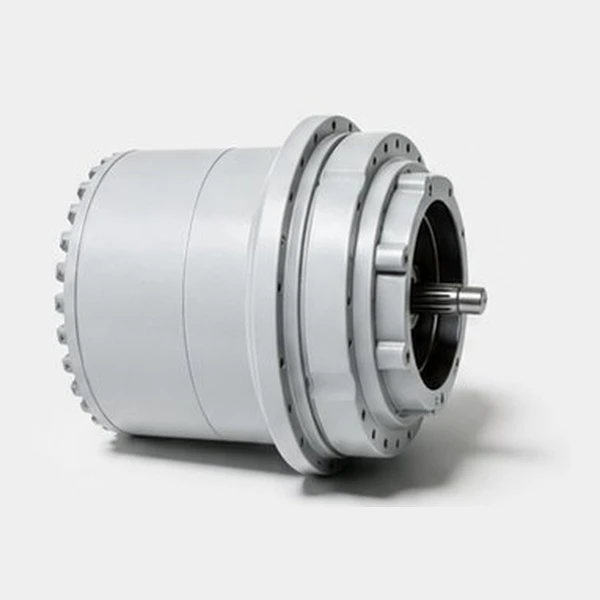
A cold milling machine (also called a cold planer or road miller) removes asphalt or concrete pavement to a precise depth using a rotating cutting drum. The machine must maintain milling depth within ±2 mm — a tolerance tighter than any other tracked construction machine achieves. To deliver this precision, the machine rides on three or four independently height-adjustable track legs, each with its own planetarisk gearkasse med bæltedrev.
Each track leg extends or retracts independently via a hydraulic cylinder — raising or lowering that corner of the machine. The cutting drum depth is set by the relative height of the legs. A road with a 2% cross-slope requires the left and right legs to be at different heights, and the front and rear legs to differ if the longitudinal grade changes. Each track drive operates at its own elevation — sometimes with 100 to 200 mm of height difference between the highest and lowest leg.
When the legs are at different heights, the machine tilts. The lowest leg carries the most weight; the highest carries the least. On a 2-metre-wide machine with a 150 mm height difference between left and right legs, the lower side carries approximately 60 to 65% of the machine weight. Each track drive must be sized for the worst-case (lowest) position — not the average quarter-share of a level machine.
All three or four track drives must propel the machine at the same forward feed rate (5 to 30 m/min) — but each operates on a different ground surface, at a different height, with a different ground contact angle and a different weight. The hydraulic circuit must balance the flow to each drive proportionally to its load — and each track drive must deliver consistent speed-per-unit-flow to maintain machine alignment over a 500-metre milling pass.
Cutting Drum Reaction Forces — The Side Load That Pushes the Machine Off Its Line
The milling drum rotates perpendicular to the direction of travel, cutting horizontally across the road width. The teeth engage the pavement surface at the leading edge and exit at the trailing edge. This engagement produces two reaction force components that the track drives must resist:
Similar to a trencher: the cutting teeth push the machine backward against the direction of travel. The track drives must overcome this reaction to maintain forward feed. On a 2-metre drum cutting 50 mm of asphalt at 15 m/min, the longitudinal reaction is typically 30,000 to 60,000 N — moderate compared to a rock trencher but sustained for hours.
The drum cuts from one side of the machine to the other. The teeth on the leading edge push material laterally toward the conveyor. This lateral force — 80,000 to 200,000 N on large cold planers — tries to push the entire machine sideways, off its milling line. The track drives on the loaded side must resist this lateral force through track-to-ground friction. No other tracked machine experiences a sustained lateral force of this magnitude during normal operation.
| Machine Class | Weight (t) | Drum Width | Track Drives | Lateral Force | Torque per Drive |
|---|---|---|---|---|---|
| Small (compact) | 8 – 15 | 500 – 1,000 mm | 3 | 30 – 60 kN | 8,000 – 18,000 Nm |
| Medium (half-lane) | 20 – 30 | 1,000 – 1,500 mm | 4 | 60 – 120 kN | 15,000 – 30,000 Nm |
| Large (full-lane) | 30 – 45 | 1,500 – 2,200 mm | 4 | 120 – 200 kN | 25,000 – 50,000 Nm |
Track Drive Sizing for a Full-Lane Cold Milling Machine
The hidden constraint — lateral stability: The torque calculation yields 6,155 Nm — modest compared to excavators or bulldozers. But the lateral force from the cutting drum (160,000 N total) must be resisted by track-to-ground friction. If the loaded-side legs do not carry sufficient weight to generate the friction force needed to resist the lateral push, the machine drifts sideways and the milling line deviates. This is why milling machine track legs are heavily ballasted and why the track drive sprocket is positioned low on the leg — to maximise the vertical force and therefore the lateral friction capacity.
Three Failure Modes Specific to Milling Machine Track Drives
The cutting drum lateral force (80,000 to 200,000 N total) is transmitted through the machine frame to the track legs. Each loaded-side leg absorbs 40 to 60% of the total lateral force as a side load on the track-to-ground interface. This side load reacts through the sprocket to the track drive output bearing as an axial force — a load direction that the standard radial bearing is not optimised to carry. Over thousands of milling hours, this sustained axial overload causes thrust-face wear on the output bearing, increasing the axial play and allowing the sprocket to shift laterally by 1 to 3 mm — enough to cause uneven track wear and eventual track derailment.
Cold milling produces a continuous stream of asphalt granules (RAP — reclaimed asphalt pavement) that falls around and under the machine. The track drives, mounted at the bottom of each leg, operate in a cloud of abrasive asphalt particles mixed with hot bitumen. These particles are stickier and more abrasive than natural soil — the bitumen binder adheres to seal faces and housing surfaces, trapping hard aggregate particles against the seal interface. Over 1,000 to 2,000 hours, the combination of adhesion and abrasion degrades the seal faster than clean-site construction.
With three or four independent track drives, each accumulates wear at a different rate — depending on its position (front left, front right, rear centre, etc.) and the proportion of machine weight it carries on each milling pass. Over 2,000 to 4,000 hours, the backlash in the most heavily loaded drive may reach 2 to 3 times the backlash in the lightest-loaded drive. This uneven backlash produces different speed responses during feed rate changes, causing the machine to yaw or crab momentarily — shifting the milling line by 5 to 15 mm. On highway projects with strict lane-edge tolerances, this crabbing is unacceptable.
Track Drive Planetary Gearbox for Milling Machines — Frequently Asked Questions
Korea Ever-Power provides cold planer track drive planetary gearboxes in matched sets of 3 or 4 from 5,000 to 50,000 Nm. Compact leg-fit envelopes, combined radial-axial output bearings, and FKM seal options for asphalt debris resistance. Provide your machine model for a matched-set recommendation.
Redaktør: Cxm