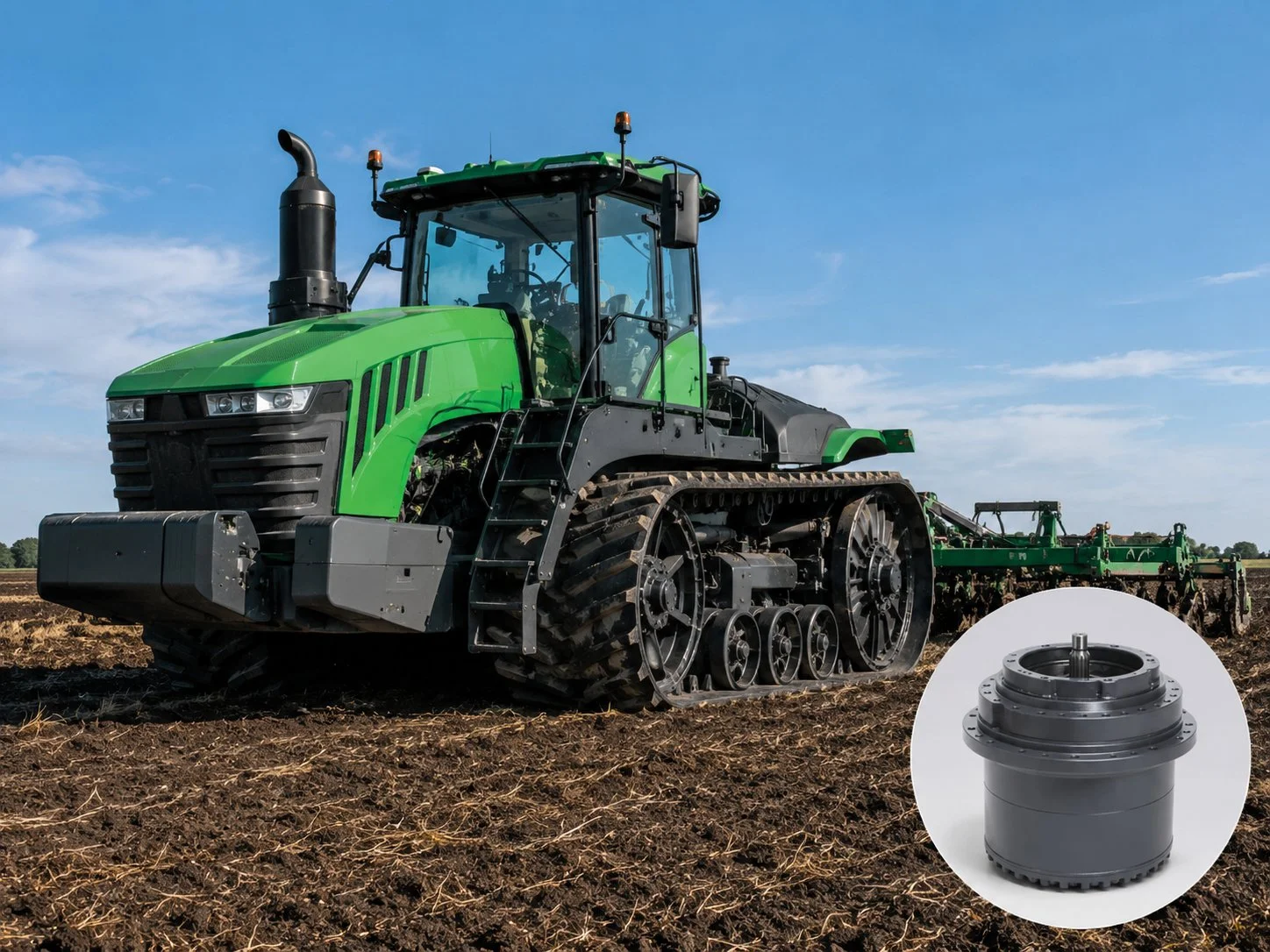
Push vs Pull — Why Crawler Tractor Track Drives Are Not Bulldozer Track Drives
A bulldozer pushes material with a blade mounted at the front. The blade reaction force pushes back against the tracks, and the track drive must overcome both the rolling resistance and the blade resistance simultaneously. A crawler tractor pulls implements — ploughs, rippers, disc harrows, pipeline sidebooms — through a drawbar or three-point hitch at the rear. The implement draft force pulls backward on the tractor, and the πλανητικό κιβώτιο ταχυτήτων με μετάδοση κίνησης σε τροχιά must overcome both the rolling resistance and the implement draft to maintain forward speed.
The mechanical loads are similar in magnitude. The difference is in the duty cycle and the speed profile:
| Παράμετρος | Bulldozer (Push) | Crawler Tractor (Pull) |
|---|---|---|
| Typical travel speed | 2 – 4 km/h (push gear) | 4 – 8 km/h (field speed) |
| Torque demand profile | Near-constant, 80 – 100% | Variable, 40 – 80% avg. |
| Direction reversals per shift | 100 – 200 (push + reverse) | 10 – 30 (headland turns) |
| Annual operating hours | 1,500 – 4,000 h/yr | 400 – 1,200 h/yr (seasonal) |
| Primary wear driver | Sustained thermal load | Seasonal storage corrosion |
| Ground conditions | Engineered surface | Natural soil, often saturated |
The key difference for track drive sizing: The crawler tractor track drive runs at higher output speed (4 to 8 km/h vs 2 to 4 km/h for a dozer) but at lower sustained torque (40 to 80% vs 80 to 100%). The higher speed means the track drive generates less heat per newton-metre of torque (the oil circulates faster, improving cooling). But the lower sustained torque does not mean the track drive can be downsized — the peak torque during implement engagement (plough hitting a rock, ripper encountering a root) can spike to 150 to 200% of the sustained draft force.
Low Ground Pressure — The Design Priority That Defines Crawler Tractor Track Drives
The primary reason to use a crawler tractor instead of a wheeled tractor is ground pressure. A wheeled tractor concentrates its weight on four tyre contact patches totalling 0.1 to 0.2 square metres. A crawler tractor distributes the same weight across two tracks totalling 0.8 to 2.0 square metres — reducing ground pressure by 5 to 15 times. This enables work on ground that a wheeled tractor would destroy.
Flooded rice paddies have a bearing capacity of 10 to 25 kPa — the softest working surface of any agricultural operation. The crawler tractor must float on the puddled surface without sinking past the top of the track shoes. Extra-wide tracks (450 to 600 mm) are used to achieve 15 to 20 kPa ground pressure. The track drive operates partially submerged in water and slurry for the entire working season — placing extreme demands on the duo-cone seal and housing corrosion resistance.
Pipeline crawler tractors (sideboom tractors) carry suspended pipe loads of 5 to 40 tonnes from a lateral boom while travelling along the pipeline right-of-way. The track drive must support the machine weight plus the pipe load at ground pressures low enough to cross wetlands, agricultural fields, and forest floor without rutting. The combination of lateral pipe load and soft-ground travel produces a unique asymmetric loading condition on the track drives — the boom-side drive carries significantly more weight than the off-side.
Draft Force Sizing — Calculating Track Drive Torque for a 12-Tonne Crawler Tractor
Unlike bulldozer and excavator track drives (where machine weight and grade dominate the torque calculation), the crawler tractor torque is dominated by the implement draft force. A heavier implement — a multi-shank ripper, a large disc harrow, or a pipeline sideboom carrying 20 tonnes of pipe — can double or triple the track drive torque requirement compared to the tractor-only rolling resistance. The track drive specification must be matched to the heaviest implement the tractor will pull, not just the tractor weight.
Seasonal Duty and Storage — The Maintenance Challenge Unique to Agricultural Crawler Tractors
Construction machines operate year-round. Agricultural crawler tractors operate seasonally — intensively for weeks during planting, tillage, and harvest, then stored for months. This seasonal pattern produces a unique track drive maintenance challenge: the gearbox spends more of its calendar life stationary than running.
Day-night thermal cycling during the off-season pumps moisture into the sealed gearbox housing through the breather. Over 4 to 8 months of storage, the accumulated moisture settles to the bottom of the oil bath and begins corroding the lowest bearing surfaces. When the tractor returns to service in spring, the contaminated oil is circulated through the entire gearbox — spreading the corrosion products to every bearing and gear surface. This seasonal condensation-corrosion cycle is the primary life-limiting mechanism for agricultural track drives — not gear tooth wear or bearing fatigue.
Duo-cone seals that remain stationary for months develop “memory” in the elastomeric O-rings — the rubber conforms to the compressed shape and loses its recovery force. When the tractor returns to service, the seal contact pressure is reduced, allowing initial oil weeping until the O-ring recovers. Additionally, the metal seal faces can develop adhesion patterns (similar to parking brake disc adhesion on crawler cranes) that require a brief high-torque breakaway to separate. Monthly manual rotation of the sprocket during storage prevents both conditions.
The single most impactful maintenance practice for agricultural crawler tractor track drives: change the oil before the first field day of the season — not after the last day. Drain the storage-contaminated oil (which may contain 500 to 2,000 ppm moisture), flush with clean oil, and refill with fresh gear oil rated for the expected field temperature. This pre-season oil change removes the accumulated condensation before it can circulate through the bearings under load. Κορέα Ever-Power recommends this protocol for all crawler tractors with seasonal operating patterns.
Three Failure Modes That Dominate Crawler Tractor Track Drive Replacements
The leading cause of agricultural track drive failure worldwide. After 4 to 8 months of storage, moisture content in the gear oil can reach 1,000 to 3,000 ppm — well above the 200 ppm threshold at which bearing corrosion initiates in standard steel. The first 50 to 100 hours of seasonal operation distributes the water-laden oil through every bearing — and the combination of water, load, and temperature accelerates corrosion faster than in-season operation ever could. A track drive that operated flawlessly at the end of last season can show bearing noise within the first week of the new season if the storage oil was not changed.
A disc plough or ripper shank striking a buried rock, root, or old fence post produces a torque spike at the track drive of 150 to 250% of the steady-state draft force. Agricultural fields — unlike engineered construction sites — contain unknown subsurface obstacles that cannot be predicted or avoided. The spike transmits through the drawbar to the tracks and into the planetary gearbox as a sudden torsional load. Over hundreds of such events per season, the sun gear spline and first-stage planet gear teeth accumulate fatigue damage that reduces the service life below the condensation-limited baseline.
Paddy-field and wetland crawler tractors operate with the track drive partially or fully submerged in water and slurry for weeks at a time. The continuous water exposure degrades the duo-cone seal O-ring elastomer (standard NBR compounds absorb water and swell, reducing contact pressure). After two to three seasons of wet-field operation, the O-ring elasticity decreases below the minimum needed to maintain seal face contact — and water begins entering the oil bath. The track drive oil turns milky within days, and bearing corrosion follows rapidly.
Track Drive Planetary Gearbox for Tractors — Frequently Asked Questions
Korea Ever-Power provides crawler tractor track drive planetary gearboxes from 3,000 to 25,000 Nm for agricultural and utility applications. FKM wet-field seals, cold-climate synthetic oil specifications, and seasonal-storage maintenance support available. Provide your tractor model and primary implement for a specification recommendation.
Επιμέλεια: Cxm