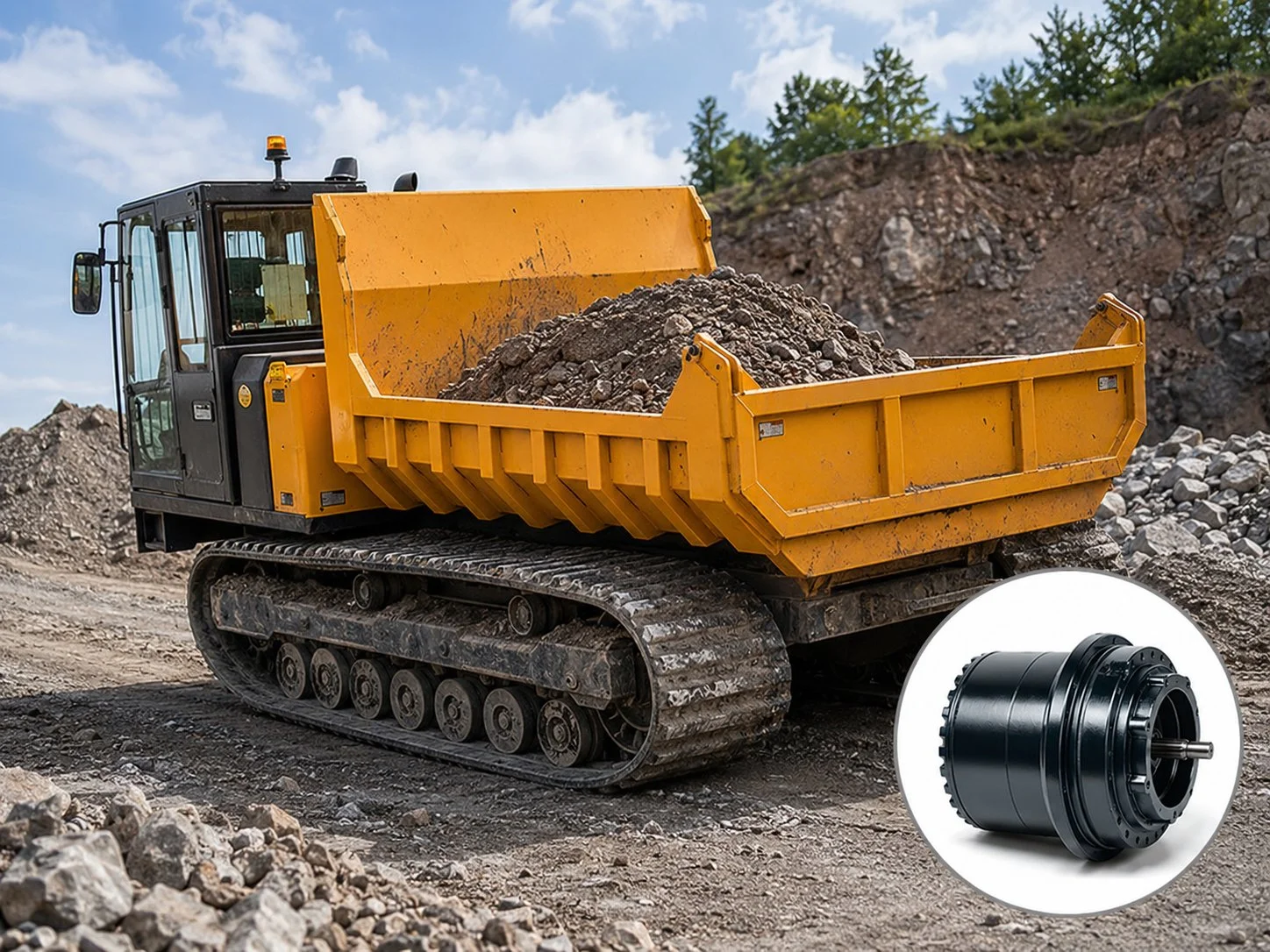
Tracked vs Wheeled Dump Trucks — The Engineering Case for Tracks on Unprepared Ground
The decision between a wheeled articulated dump truck (ADT) and a tracked dump truck (also called a tracked carrier or crawler carrier) is fundamentally a ground condition decision. On a well-maintained gravel haul road, the wheeled ADT is faster, cheaper per tonne-kilometre, and more fuel-efficient. On anything softer — and “softer” includes most conditions encountered in reclamation, landfill, pipeline, peat, and wet-season earthmoving — the tracked dumper delivers the payload while the wheeled hauler cannot.
| パラメータ | Wheeled ADT (30 t payload) | Tracked Dumper (15 t payload) |
|---|---|---|
| Ground pressure (loaded) | 180 – 350 kPa | 30 – 55 kPa (6x lower) |
| Soft ground trafficability | Fails below CBR 8 | Operates to CBR 2 – 3 |
| Max grade (loaded, soft) | 8 – 12% (traction limited) | 20 – 30% (engine limited) |
| Loaded speed (flat) | 25 – 40 km/h | 8 – 12 km/h |
| Ground damage | Severe rutting on soft ground | Minimal — distributes load |
| Final drive type | Wheel drive planetary gearbox | Track drive planetary gearbox |
| Fuel per tonne-km | Lower (on good road) | Higher (track friction) |
The break-even point: When the ground CBR (California Bearing Ratio) falls below 8 — roughly the condition of a wet clay site after rain — the wheeled ADT begins to lose traction, sink into ruts, and require haul road maintenance. Below CBR 4, the wheeled ADT cannot operate at all. The tracked dumper continues working to CBR 2 to 3, eliminating the haul road construction and maintenance cost entirely. For sites where ground improvement would cost more than the tracked dumper productivity reduction (lower speed, lower payload per trip), the tracked option is the economically rational choice regardless of the per-tonne-km fuel premium.
Grade Resistance with Payload — The Load Case That Sizes Tracked Dumper Track Drives
A tracked dump truck carries its payload uphill. Every metre of elevation gain at full payload requires sustained torque at the track drives — torque that must be maintained for the entire haul distance, which can be 200 to 2,000 metres on large earthmoving and reclamation projects. This sustained loaded-uphill duty is the defining track drive load case for dump trucks.
On a compacted gravel haul road, rolling resistance is 3 to 4% of GVW. On soft clay, it rises to 8 to 12%. On peat or landfill waste, it can reach 15 to 20%. At 15% rolling resistance on a 20% grade, the rolling resistance force nearly equals the grade resistance force — meaning the total track drive torque requirement is nearly double what the grade calculation alone predicts. Engineers who size the track drive for grade resistance only, ignoring the soft-ground rolling resistance, undersize the gearbox by 30 to 50%.
The tracked dumper hauls uphill (loaded, high torque, high heat) and returns downhill (empty, low torque, engine braking). The return trip is a cooling interval — the track drive oil temperature decreases during the downhill coast. This natural thermal cycle is unique to hauling applications and gives the track drive a thermal rest that bulldozers never receive. The effective duty cycle for thermal sizing is 50 to 60% — lower than a bulldozer (75 to 85%) despite the dumper working continuously for the entire shift.
Payload-to-Weight Ratio — Why Tracked Dumpers Need More Torque Per Tonne Than Wheeled Haulers
A wheeled ADT typically carries a payload equal to its empty weight — a 30-tonne truck carries 30 tonnes, doubling the GVW. A tracked dumper carries a payload of 60 to 90% of its empty weight — an 18-tonne machine carries 15 tonnes, increasing the GVW by 83%. The tracked dumper is heavier per tonne of payload because of the track undercarriage, which weighs 30 to 50% more than the equivalent wheeled running gear.
This lower payload-to-weight ratio means the tracked dumper must move more dead weight per tonne of payload hauled — increasing the torque requirement at the track drives per unit of productive capacity. On flat, firm ground, this makes the tracked dumper less efficient than the wheeled ADT. But on soft ground where the wheeled ADT cannot operate at all, the comparison is irrelevant — the tracked dumper is 100% productive while the wheeled option is 0% productive.
Five Applications Where Tracked Dump Trucks Eliminate Wheeled Hauler Limitations
The tracked dump truck is not a general-purpose hauler. It is a specialist machine that excels in five specific conditions where wheeled trucks fail or where the cost of making a wheeled truck operational (haul road construction and maintenance) exceeds the cost of the tracked truck productivity reduction.
Waste material CBR: 1 to 3. Wheeled trucks sink immediately. Tracked dumpers haul cover material across active landfill cells without ground improvement. The track drive operates in the most corrosive environment of any hauling application — landfill leachate attacks seals and housing surfaces.
Newly deposited dredge fill has near-zero bearing capacity until it consolidates. Tracked dumpers spread fill across the surface, distributing weight to avoid punching through the unconsolidated layer. The track drive must operate partially submerged in saturated sand and water at every cycle.
Pipeline right-of-way haul paths cross agricultural land, wetlands, and forested terrain where haul road construction is prohibited or impractical. Tracked dumpers haul pipe, backfill material, and equipment along the corridor with minimal surface disturbance. Korea Ever-Power planetary gearboxes serve the complete pipeline equipment fleet.
Peat bearing capacity: 10 to 25 kPa — well below any wheeled vehicle. Tracked dumpers with wide tracks (500 to 700 mm) achieve ground pressures of 20 to 30 kPa, enabling material transport across active peat extraction zones without ground collapse.
During monsoon and rainy seasons in tropical construction, wheeled haulers are grounded for weeks. Tracked dumpers continue operating on saturated soil — maintaining the project schedule when weather shuts down the wheeled fleet. The additional fuel cost per tonne is offset by the elimination of weather-delay penalties.
Three Track Drive Failure Modes Specific to Tracked Dump Truck Service
Unlike a bulldozer that pushes for 60 to 120 metres per pass, a tracked dump truck hauls uphill for 200 to 2,000 metres per trip — at sustained near-maximum torque on soft ground. The combined grade resistance plus soft-ground rolling resistance produces continuous heat input to the track drive oil bath for 3 to 15 minutes per loaded trip. On long haul routes in hot climates, the oil temperature can exceed 110 degrees C before the loaded trip is complete. Repeated thermal cycling above the oil film threshold accelerates gear tooth surface fatigue.
Landfill leachate (pH 5 to 8, containing dissolved metals and organic acids) and saltwater (reclamation sites) attack the track drive housing, seal faces, and fastener threads. Over 2,000 to 4,000 hours of operation in these environments, housing surfaces corrode, seal lip material degrades, and bolt torque relaxes as corrosion weakens the clamping interface. The gearbox housing, which appears structurally sound, may have 20 to 30% reduced wall thickness at corrosion hotspots.
A tracked dump truck loaded by an excavator often receives material unevenly — more weight on one side of the body than the other. On a 15-tonne payload, a 60/40 split puts 9 tonnes over one track and 6 tonnes over the other — a 50% load asymmetry. The heavier track drive operates at 120 to 130% of the nominal per-track loading, while the lighter side operates at 70 to 80%. Over thousands of haul cycles, the heavily loaded side accumulates disproportionate bearing and gear wear, resulting in one track drive failing while the other still has 40 to 60% of its remaining life.
Track Drive Planetary Gearbox for Dump Trucks — Frequently Asked Questions
Korea Ever-Power provides tracked dump truck track drive planetary gearboxes from 10,000 to 80,000 Nm — covering 6-tonne site dumpers through 30-tonne articulated tracked carriers. Corrosion-protected options available for landfill and reclamation duty. Provide your machine model and site conditions for a specification recommendation.
編集者: Cxm