What Is a Demolition Robot — And Why Its Track Drive Is the Most Stressed Per Kilogram
A demolition robot (also known as a remote-controlled demolition machine) is a compact, electrically or hydraulically powered tracked machine designed to work where humans and full-size excavators cannot: inside buildings being demolished, in tunnels, in nuclear decommissioning zones, on elevated floors with weight restrictions, and in confined industrial spaces. The machines range from 1 to 12 tonnes — with the 3 to 6 tonne class being the most common.
O caixa de engrenagens planetária de acionamento por esteira on a demolition robot must deliver the same performance characteristics as a 15 to 25 tonne excavator track drive — counter-rotation steering, gradeability, vibration resistance — but in a package that weighs 30 to 50% less and occupies 40 to 60% less volume. This is the definition of power density: more newton-metres per kilogram and per cubic centimetre than any other track drive application in the equipment industry.
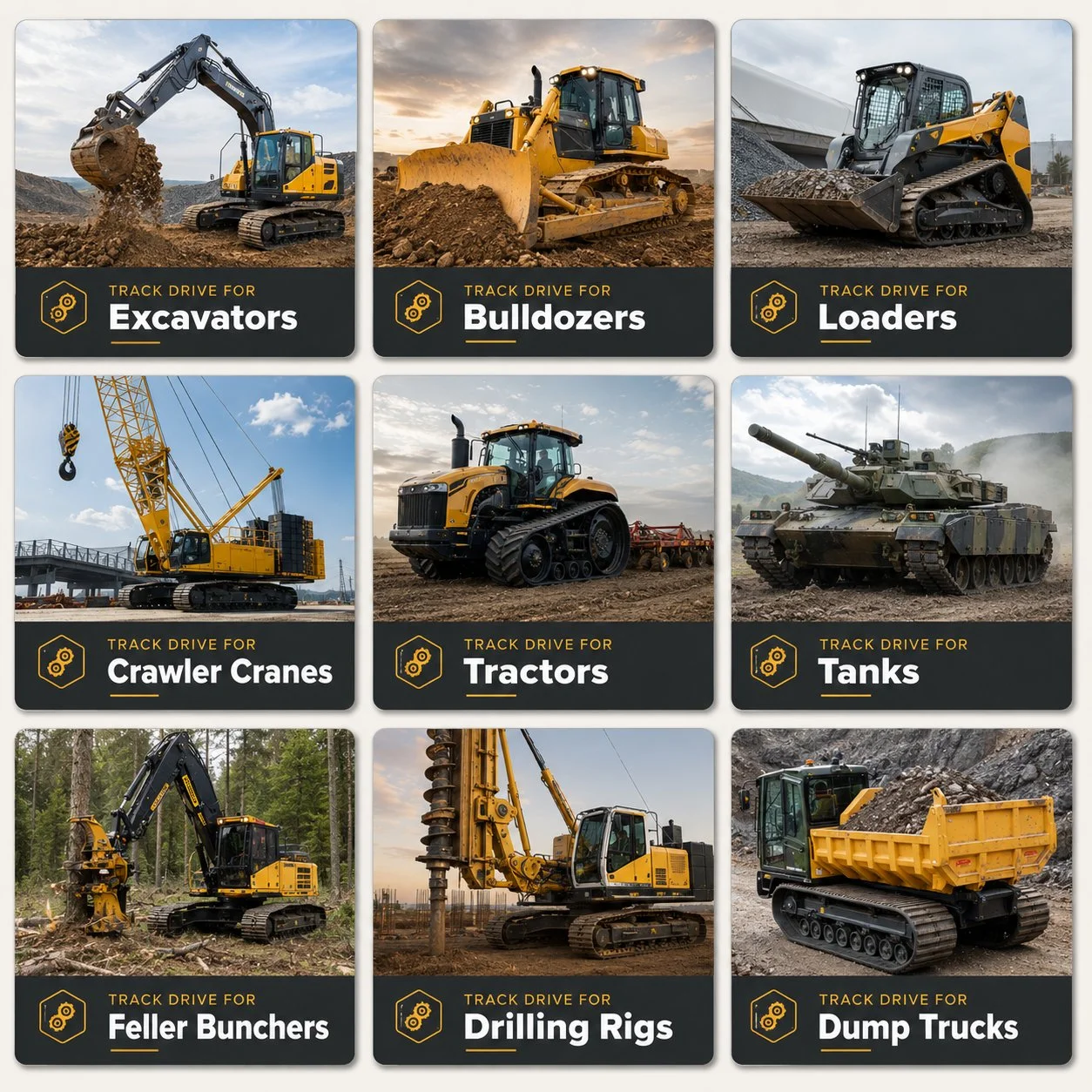
Compact track drive assembly: the same planetary gear principle as a 30-tonne excavator — but engineered to fit inside a 3-tonne demolition robot undercarriage.
Power Density — Why a 6-Tonne Robot Needs the Track Drive Torque of a 20-Tonne Excavator
A 6-tonne demolition robot carries a hydraulic breaker rated at 1,500 to 2,500 joules — the same breaker class fitted to 18 to 25 tonne excavators. The robot achieves this mismatch through a higher power-to-weight ratio: 30 to 50 kW per tonne versus 8 to 12 kW per tonne on a standard excavator. The consequence for the track drive is severe: the machine generates forces disproportionate to its weight, and the track drive must handle these forces in a housing and gear set that is sized for the smaller machine footprint.
| Parâmetro | 6 t Demolition Robot | 20 t Excavator |
|---|---|---|
| Engine/motor power | 120 – 160 kW | 110 – 130 kW |
| Power-to-weight ratio | 20 – 27 kW/t | 5.5 – 6.5 kW/t |
| Breaker class | 1,500 – 2,500 J | 1,200 – 2,000 J |
| Track drive torque | 8,000 – 18,000 Nm | 28,000 – 50,000 Nm |
| Track drive weight | 25 – 55 kg | 120 – 200 kg |
| Torque per kg of drive | 320 – 330 Nm/kg | 230 – 250 Nm/kg |
The demolition robot track drive achieves 30 to 40% higher torque-per-kilogram than a standard excavator track drive — the price of fitting excavator-class performance into a robot-class envelope.
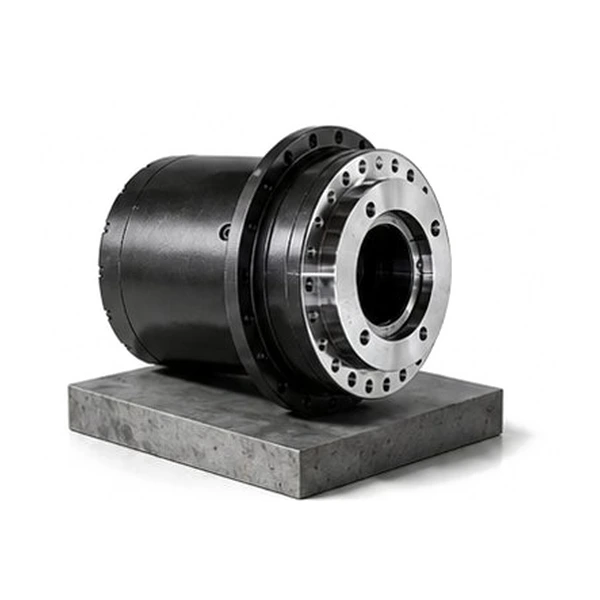
Compact planetary reducer. Demolition robot track drives use similar 2 to 3 stage planetary architectures compressed into housings 40 to 60% smaller by volume than excavator equivalents.
Breaker Vibration — The Continuous Impact That Travels Through the Chassis to the Track Drive
A hydraulic breaker strikes 600 to 1,200 times per minute at 1,500 to 2,500 joules per blow. Each strike generates a vibration impulse that propagates through the boom, the turret, the chassis, and into the track drives. On a 20-tonne excavator, the large chassis mass attenuates this vibration before it reaches the track drives — the ratio of machine mass to impact energy is high. On a 6-tonne demolition robot, the ratio is 3 times lower — the vibration reaches the track drives at 3 times the amplitude per unit of machine mass.
The high-frequency vibration causes micro-oscillation of the planet pin bearings — the rollers rock back and forth without completing a full revolution. This “fretting” removes the oil film from a narrow band of the bearing raceway, producing a wear pattern (false brinelling) unique to vibration-loaded bearings. Over 2,000 to 4,000 hours, the fretting marks deepen into pits that propagate into spalling.
The continuous vibration at 10 to 20 Hz (breaker frequency) fatigues the track drive mounting bolts through preload relaxation and cyclic stress at the bolt head radius — the same mechanism that loosens trencher bolts, but at higher frequency and closer proximity to the vibration source. Without thread-locking compound, mounting bolts can loosen within 200 to 500 hours.
Vibration isolation is not possible: Unlike an engine (which is rubber-mounted to isolate vibration), the track drive is rigidly bolted to the track frame — it must be, because any compliance in the mounting would allow the sprocket to shift and derail the track. The track drive must be designed to withstand the transmitted breaker vibration as a continuous operating condition, not an occasional event.
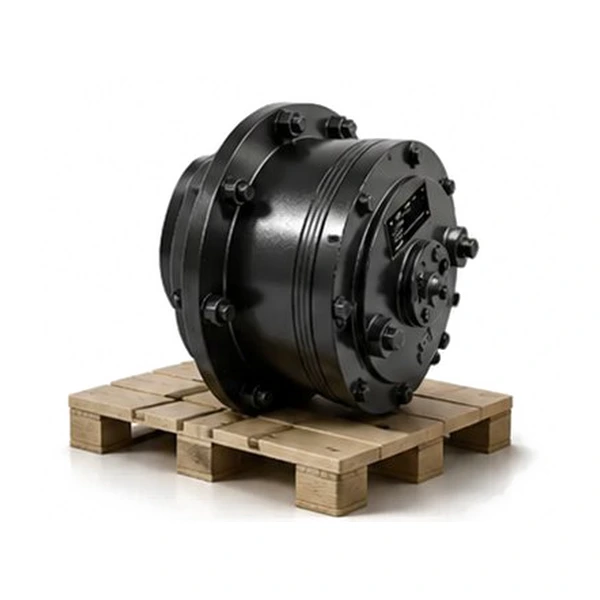
Robust bearing and housing structure. Robot track drives use full-complement needle bearings (no cage) for maximum radial capacity within the compact envelope.
Confined-Space Operation — Five Environments That Only Demolition Robots Can Enter
Inside buildings with floor load limits of 500 to 2,000 kg/m2 — too low for any excavator but within the ground pressure range of a 3 to 6 tonne robot on wide tracks. The track drive must propel across concrete floors, over rebar, and through rubble piles in spaces as narrow as 800 mm.
Tunnel cross-sections, mine drifts, and underground chambers where ceiling height limits the machine to under 2 metres. The track drive must handle slopes of 10 to 25% on wet, uneven tunnel floors. Water ingress and high humidity accelerate seal and housing corrosion in underground environments.
Radiation-contaminated zones where human access is prohibited. The robot is controlled remotely, and the track drive must operate for the entire shift without manual intervention. Any track drive failure requires a contamination-controlled recovery operation that can cost 10 to 50 times the value of the gearbox itself.
Slag removal, furnace lining demolition, and ladle cleaning inside steel mills and foundries. Ambient temperatures of 40 to 60 degrees C at the machine level, with radiant heat from molten metal reaching 80+ degrees C at the track drive housing. The thermal environment approaches asphalt paver conditions — but with the added challenge of metal dust and slag particles.
Cement kiln cleaning, chemical reactor vessel demolition, and refinery unit turnaround work. The track drive must propel through chemical residues, cement clinker, and process dust — corrosive and abrasive environments that combine the worst characteristics of Korea Ever-Power planetary gearbox applications across multiple industries.
Three Failure Modes Specific to Demolition Robot Track Drives
The high-frequency micro-oscillation from the breaker (10 to 20 Hz, 600 to 1,200 impacts per minute) causes the planet pin bearing rollers to rock without rotating. This removes the oil film from a narrow contact band and produces a wear pattern identical to static indentation. After 2,000 to 4,000 hours, the false brinelling marks become deep enough to generate vibration and noise — and then propagate rapidly into full spalling.
The compact housing has thinner walls than an excavator track drive of the same torque class — the volume constraint demands it. Thinner walls have less fatigue margin. The breaker vibration adds a continuous cyclic stress component on top of the static torque load. At stress concentration points (bolt holes, seal grooves, internal corners), the combined steady + cyclic stress can exceed the fatigue endurance limit of standard ductile iron within 3,000 to 5,000 hours.
Demolition robots operate surrounded by the material they are demolishing — concrete chips, rebar fragments, brick dust, and plaster particles. The track drives, at ground level, are buried in this debris. Unlike outdoor construction (where wind and rain disperse debris), indoor demolition concentrates the debris around the machine with no natural clearance. Concrete dust is as abrasive as rock dust (Mohs 6 to 7) and combines with water from dust suppression systems to form an abrasive paste that accelerates seal wear.

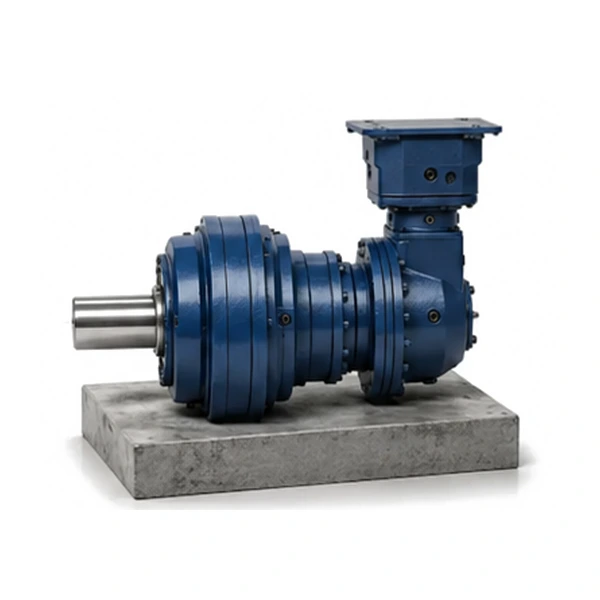
Multi-stage planetary architecture. Demolition robot drives use 2 to 3 stage configurations to achieve ratios of 50:1 to 120:1 within the compact housing envelope.
Track Drive Planetary Gearbox for Demolition Robots — Frequently Asked Questions
Korea Ever-Power provides demolition robot track drive planetary gearboxes from 3,000 to 18,000 Nm — the highest torque-per-kilogram in the track drive catalogue. Vibration-rated bearings, compact QT600-3 housings, and nuclear/hazardous-environment specifications available. Provide your robot model and breaker class for a specification recommendation.
Editor: Cxm