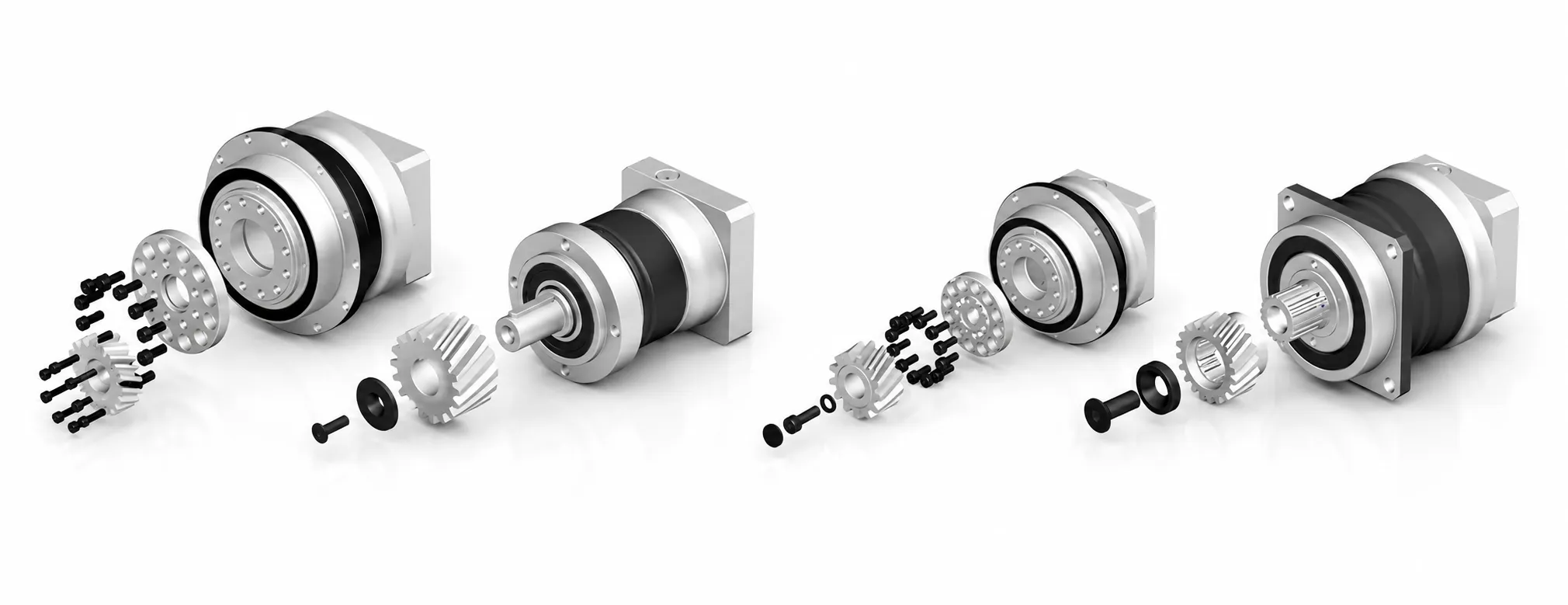
Why Inertia Ratio Controls Servo Performance — The Physics Behind the Rule
Every planetary gearbox inertia matching guide and servo motion control textbook states a rule: keep the load-to-motor inertia ratio below a target value — commonly cited as 5:1, 10:1, or 30:1 depending on the source. Korean engineers who follow this rule without understanding its physical origin often apply it incorrectly — choosing targets that are either too conservative (forcing an unnecessarily large gearbox) or too permissive (accepting instability they cannot tune away).
The physical origin of the inertia ratio limit is the servo control loop’s ability to reject torque disturbances. Consider a servo motor driving a load through a gearbox. The motor encoder measures motor shaft position; the servo controller computes a torque command to correct position error. When an external disturbance torque acts on the load — a cutting force, an impact, a sudden friction change — the motor must produce a corrective torque to restore the commanded position. The speed at which the motor can detect and correct the disturbance is the servo loop bandwidth.
THE INERTIA RATIO AND BANDWIDTH RELATIONSHIP
T_motor = (J_motor + J_load/i²) × α_motor + T_friction
Define: J_total = J_motor + J_load/i²
J_ratio = J_load_reflected / J_motor = (J_load/i²) / J_motor
Servo bandwidth ω_c (rad/s) — simplified open-loop:
ω_c ∝ K_p / J_total = K_p / [J_motor × (1 + J_ratio)]
→ Achievable bandwidth decreases as J_ratio increases
→ At J_ratio = 1: bandwidth = K_p / (2 × J_motor) — 50% of ideal
→ At J_ratio = 5: bandwidth = K_p / (6 × J_motor) — 17% of ideal
→ At J_ratio = 10: bandwidth = K_p / (11 × J_motor) — 9% of ideal
This bandwidth reduction limits how fast the servo can:
• Respond to position commands (limits acceleration profile steepness)
• Reject disturbances (limits stiffness against cutting/impact forces)
• Settle to target position (limits positioning time)
The inertia ratio rule is not a binary pass/fail threshold — it is a continuous performance trade-off. J_ratio = 3 does not mean “acceptable” and J_ratio = 4 mean “unacceptable.” It means that at J_ratio = 4, the achievable bandwidth is 20% of the single-inertia ideal, and at J_ratio = 3 it is 25%. Whether that 5 percentage point difference matters depends on the application’s required acceleration profile and disturbance rejection.
For planetary gearbox inertia matching in Korean industrial practice, the target J_ratio thresholds differ by application type. High-dynamic packaging and robot joint axes target J_ratio ≤ 3. General servo positioning axes accept ≤ 10. Speed-controlled drives (conveyors, screw rotation) are often comfortable at ≤ 30. The gear ratio selection problem is to find the ratio that places the reflected inertia within the appropriate J_ratio target for the application.
Reflected Inertia Calculations — Three Drive Topologies in One Reference
The reflected inertia formula differs for each drive topology — direct rotary coupling, linear motion via ball screw or rack-and-pinion, and belt or chain drive. Korean engineers working across different machine types frequently apply the rotary formula to a linear drive or forget to include the gearbox’s own inertia contribution. The following derivations cover all three topologies correctly.
① Direct rotary coupling — rotating load (turntable, joint)
Total reflected inertia at motor:
J_total = J_motor + J_gearbox_input + J_load/i²
J_ratio = J_load_reflected / J_motor
= J_load / (i² × J_motor)
Note: J_gearbox_input is provided in
Korea Ever-Power EP datasheet (typically
5–15% of J_motor for standard servo motor)
Key insight: J_ratio improves as i². Doubling the ratio reduces reflected inertia by 4×. This is why a 3:1 ratio reduces a 36:1 J_ratio to just 4:1 (= 36/3²).
② Linear motion — ball screw or rack-and-pinion (linear axis)
J_mass_at_screw = m × (L/2π)²
With gearbox ratio i (motor→screw):
J_mass_reflected = m × (L/2π)² / i²
Also include: J_screw = ½ × m_screw × r_screw²
J_screw_reflected = J_screw / i²
Rack-and-pinion (pinion on gearbox output):
J_mass_reflected = m × r_pinion² / i²
(m = total moving mass, r_pinion = pitch radius)
Key insight: For linear motion, the load inertia depends on both machine mass AND the mechanism geometry (lead or pitch radius). A heavy machine table is not necessarily high inertia — a short lead ball screw dramatically reduces reflected inertia.
③ Belt or chain drive — reel or pulley load (film reel, conveyor)
J_load_at_drive_pulley = m × r_pulley²
With gearbox ratio i (motor→drive pulley):
J_load_reflected = m × r_pulley² / i²
Also include rotating reel/drum:
J_reel = ½ × m_reel × r_reel²
J_reel_reflected = J_reel / i²
Variable reel radius (film depleting):
Calculate at r_full and r_empty;
worst case is r_full (maximum J)
Key insight: Film reels present the most extreme J_ratio variation — from near-zero (empty reel) to maximum (full reel). The system must be stable at both extremes. Gear ratio is chosen to keep the full-reel J_ratio at the target; the empty-reel condition is then motor-dominated and inherently stable.
| Drive Topology | J_load_reflected formula | Scales as | Worst-case condition |
|---|---|---|---|
| Rotary (direct) | J_load / i² | 1/i² | Full load, maximum J_load |
| Ball screw linear | m×(L/2π)² / i² | 1/i² | Maximum table/load mass |
| Rack and pinion | m×r_pinion² / i² | 1/i² | Maximum carriage mass |
| Belt / film reel | m×r_pul² / i² + J_reel/i² | 1/i² | Full reel radius, maximum load |
The Optimal Gear Ratio for Inertia Matching — Derivation and Practical Application
There is a mathematically optimal gear ratio for a given motor and load — the ratio that minimises the total effective inertia seen by the servo control loop, producing the highest possible servo acceleration for a given motor torque. Korean servo engineers who know this formula can select their first-pass gear ratio analytically rather than iteratively.
OPTIMAL RATIO DERIVATION
J_total = J_motor + J_gearbox + J_load/i²
Maximise α by minimising J_total with respect to i:
d(J_total)/di = -2×J_load/i³ + 0 = 0… wait,
this isn’t the right objective. The true objective:
Maximise load acceleration α_load = α_motor / i
= T_motor / [i × (J_motor + J_gearbox + J_load/i²)]
d(α_load)/di = 0 → solving:
i_optimal = √(J_load / (J_motor + J_gearbox))
At i_optimal: J_ratio = J_load/i² / J_motor ≈ 1.0
(reflected load inertia = motor inertia)
This gives J_ratio ≈ 1 at the optimal ratio —
the load appears to the motor as an equal mass.
The optimal ratio formula has a beautifully simple physical interpretation: the gear ratio that maximises load acceleration is the one that makes the reflected load inertia equal to the motor inertia. At this ratio, exactly half the motor torque accelerates the motor itself and half accelerates the load — a 50/50 split that is thermodynamically efficient and mechanically balanced.
In practice, i_optimal often falls between standard catalogue ratio steps. A Korean servo engineer who calculates i_optimal = 17.3 must choose between i = 15 and i = 20 from the catalogue. Both are acceptable — the inertia ratio varies only modestly across this range. The engineer should also verify that the chosen ratio delivers the required output speed at the motor’s rated RPM.
For applications where the optimal ratio falls between standard EP-AB catalogue steps (e.g. i=20 and i=25), the EP-ADS series offers non-standard ratios (i=16, 21, 31, 61, 91) that more closely match the calculated optimum. For applications where exact inertia optimisation justifies the non-standard ratio, ADS avoids the need for VFD frequency adjustment to compensate for a ratio mismatch.

The i² Law — Why a Small Ratio Change Has a Large Inertia Effect
The most important practical insight from the reflected inertia formula is the i² scaling: the reflected load inertia decreases with the square of the gear ratio. This makes gear ratio selection a far more powerful inertia management tool than changing the motor or moving hardware.
A Korean machine builder who is struggling with a J_ratio of 40:1 (servo tuning unstable, machine constantly hunting) does not need a larger motor — they need a higher gear ratio. Doubling the ratio from i=5 to i=10 reduces reflected inertia by 4×, dropping the J_ratio from 40:1 to 10:1. Doubling again to i=20 drops it to 2.5:1. These ratio changes cost almost nothing (stepping up one ratio in the same gearbox frame often has negligible price difference) but produce dramatic servo performance improvements.
| Σχέση μετάδοσης i | i² factor | J_load_reflected (J_load = 100 kg·cm²) | J_ratio (J_motor = 5 kg·cm²) | Performance zone |
|---|---|---|---|---|
| i = 3 | 9 | 11.1 kg·cm² | 2.2 : 1 | ✅ Εξαιρετικό |
| i = 5 | 25 | 4.0 kg·cm² | 0.8 : 1 | ✅ Near-optimal |
| i = 10 | 100 | 1.0 kg·cm² | 0.2 : 1 | ✅ Motor-dominated |
| i = 2 (no gearbox) | 4 | 25.0 kg·cm² | 5.0 : 1 | ⚠ Borderline |
| i = 1 (direct) | 1 | 100 kg·cm² | 20 : 1 | ❌ Difficult to tune |
Example: J_load = 100 kg·cm² (rotating turntable + part), J_motor = 5 kg·cm². i_optimal = √(100/5) = 4.47 → nearest standard ratio i=5 gives near-optimal J_ratio = 0.8:1.
Korean engineers who specify direct-drive (no gearbox, coupling only) to simplify machine design often end up with J_ratio of 10:1 to 30:1 — requiring very conservative servo gains that limit achievable acceleration. A small gear ratio (i=3 to i=5) dramatically improves the servo bandwidth without significantly limiting output speed, because the same motor at 3,000 rpm produces 1,000 rpm output at i=3 — adequate for most rotary table and robot joint applications. The “no gearbox = better performance” intuition is only correct when the load is inherently well-matched to the motor — a rare condition in practice.
Three Korean Application Case Studies — Complete Inertia Matching Calculations
Korean HFFS Packaging — Film Reel Pull Axis
Problem: Film reel drive axis is unstable during deceleration at high speed. Motor: J_motor = 0.8 kg·cm². Full reel: Ø600mm, 25 kg (J_reel = 2,812 kg·cm²). Drive pulley r = 50 mm (J_pulley = 0.15 kg·cm²). Linear film mass 2 kg on belt. Current ratio: i = 5.
J_pulley_reflected = 0.15 / 25 = 0.006 kg·cm²
J_mass_reflected = m × r² / i² = 2 × 50² / 25 = 200 kg·cm²
J_total_load_reflected = 112.5 + 0.006 + 200 = 312.5 kg·cm²
J_ratio = 312.5 / 0.8 = 390:1 ← severely mismatched
i_optimal = √(312.5 / 0.8) = √390.6 = 19.8 → use i = 20
At i = 20: J_ratio = 2,812/(400×0.8) + 2×50²/(400×0.8) = 8.8+31.3 = 40.1:1
Still high → i = 25: J_ratio = (2812+2×50²)/(625×0.8) = 7.7:1 ✓ acceptable
Διάλυμα: Upgrade from i=5 to i=25 (EP-AF090 P1 two-stage). J_ratio drops from 390:1 to 7.7:1 — within acceptable range for HFFS speed control. This result matches the Art10 recommendation and now shows the mathematical basis for that choice.
Korean 5-Axis Machining Centre — Rotary B-Axis Table
Problem: Select optimal ratio for B-axis rotary table. Motor: J_motor = 4.2 kg·cm². Table + fixture: J_table = 380 kg·cm² (varies 200–500 with workpiece). Target: J_ratio ≤ 5:1 at maximum load.
→ Nearest standard ratios: i=10 and i=12 (EP-AFH catalogue)
At i=10: J_ratio = 500/(100×4.2) = 1.19:1 (excellent but may over-reduce speed)
At i=15: J_ratio = 500/(225×4.2) = 0.53:1 (motor-dominated, very stable)
Check output speed at i=10, n_motor=3000rpm: n_out=300rpm ← too fast for B-axis
Check output speed at i=50, n_motor=3000rpm: n_out=60rpm ← typical B-axis ✓
At i=50: J_ratio = 500/(2500×4.2) = 0.048:1 ✓ motor-dominated
Διάλυμα: EP-AFH i=50 two-stage. At this ratio the rotary table is completely motor-inertia-dominated — the load contribution is negligible — and the servo loop is controlled almost entirely by motor properties. This is why high-ratio CNC rotary tables are inherently easy to tune regardless of workpiece weight variation.
Korean E-Commerce AMR — Drive Wheel Inertia Matching
Problem: 500 kg payload AMR, wheel radius r=0.10m, J_motor = 0.35 kg·cm². Effective rotary inertia of vehicle+payload at wheel: J_vehicle = m × r² = 700 × 100² = 7,000,000 kg·cm².
This is impractically high — need to reconsider.
Better model: treat as linear mass at wheel output:
At gearbox output (wheel shaft): effective inertia = m × r² = 700×0.1² = 7 kg·m² = 70,000 kg·cm²
With gearbox i: J_reflected = 70,000 / i²
Target J_ratio ≤ 10 (speed control, moderate dynamic):
J_ratio = 70,000 / (i² × 0.35) ≤ 10
i² ≥ 70,000 / (10 × 0.35) = 20,000
i ≥ √20,000 = 141 ← extremely high
Practical: use i=20 (EP-AB060 P2), accept J_ratio = 70,000/(400×0.35) = 500:1
Use velocity control (not position), rely on odometry correction. ✓
Insight: AGV drive wheels are fundamentally inertia-mismatched in the gearbox sense — the vehicle mass is so large that matching it to a compact motor would require impractically high ratios. The correct architecture is velocity control with outer-loop position correction from navigation sensors, not tight inertia matching. This is why AGV drives are specified on torque, noise, and speed sync (Art12) — not on inertia ratio.
Gearbox Input Inertia — The Term Korean Engineers Most Often Omit
The correct reflected inertia formula at the motor shaft is:
The middle term — J_gearbox_input — is the rotational inertia of the gearbox’s input-side rotating components (sun gear, input bearing inner rings, motor adapter). This term is published in Korea Ever-Power EP series datasheets and typically represents 5–20% of the motor rotor inertia for standard servo motor pairings.
For most applications, omitting J_gearbox_input introduces a 5–15% error in the inertia ratio calculation — small enough that it does not change the gear ratio selection. However, for two cases it matters significantly:
When J_load/i² is comparable to J_motor (i.e. the system is near the optimal ratio), the gearbox input inertia may push the total past the J_ratio target. Always include J_gearbox_input when J_ratio is calculated to be below 3:1 — the correction may push it above the target.
At high input speeds, the gearbox input stage generates bearing centrifugal loads and churning losses that are themselves speed-dependent. For ratios above 3,000 rpm input, include J_gearbox_input and verify against the maximum input speed specification for the selected EP series frame and ratio.
| Σειρά EP | Πλαίσιο | J_gearbox_input (typical, kg·cm²) | % of typical servo J_motor |
|---|---|---|---|
| EP-AB | 042 | 0.05–0.10 | ~8% |
| EP-AB | 060 | 0.15–0.30 | ~10% |
| EP-AB | 090 | 0.50–1.20 | ~12% |
| EP-AB | 115 | 1.5–3.5 | ~15% |
| EP-AH New Line | 200 | 8–20 | ~20% |
Indicative values. Confirm exact J_gearbox_input from Korea Ever-Power EP series datasheet for your specific model and ratio. Values are for single-stage; two-stage adds the input-stage planet carrier inertia contribution.
When Deliberate Inertia Mismatch Is the Correct Engineering Choice
The inertia matching guideline is a performance optimisation tool, not a constraint that must always be met. There are three legitimate engineering scenarios where a Korean machine designer may deliberately accept a J_ratio outside the recommended range.

AGV drives (Case 3 above), conveyor head drums, and screw rotation axes all operate at J_ratio far above the standard guideline — but they use velocity control with outer-loop position correction from encoders, sensors, or navigation systems. In these cases the servo loop does not need tight inertia matching; it needs reliable speed control, which works acceptably at J_ratio up to 30:1 or more with well-tuned velocity PI gains.
If the required output speed range dictates a low ratio (e.g. i=3 for a high-speed indexer that must reach 500 rpm output from a 1,500 rpm motor), and this produces J_ratio = 15:1, the engineer should accept the mismatch and compensate through motor sizing: specifying a motor with higher rotor inertia (typically a larger frame motor in the same power class) to reduce J_ratio without changing the gear ratio.
CNC rotary table with variable workpiece weight (empty 50 kg to full 500 kg) has a 10:1 inertia variation that no fixed gear ratio can simultaneously optimise for both extremes. The standard approach is to select the ratio that keeps J_ratio ≤ 5:1 at the maximum load condition — accepting that at minimum load the system is over-reduced and slightly less efficient, but stable at both extremes.
Inertia-Based Gear Ratio Selection — Complete Step-by-Step Procedure
The following six-step procedure applies to any Korean servo axis. Steps 1–3 determine whether inertia or speed is the binding constraint on ratio selection; steps 4–6 confirm the chosen ratio against all remaining criteria.
Calculate required output speed range
n_out_max = maximum axis speed (rpm) from machine spec. n_out_min (if applicable). This gives the speed-based ratio limit: i_speed = n_motor_rated / n_out_max. This is the minimum allowable ratio — ratios below this exceed motor rated speed.
Calculate load inertia at the output shaft
Use the appropriate formula from Module 2 for your drive topology. For variable-load applications (workpiece changes, film reel depleting), calculate at the worst case (maximum inertia condition). Include all rotating and translating masses connected to the output shaft.
Calculate optimal ratio and J_ratio at each candidate ratio
i_optimal = √(J_load / J_motor). Calculate J_ratio at catalogue ratios near i_optimal. Select the ratio that meets the J_ratio target for your application type (from Module 3 table) while also satisfying i ≥ i_speed from Step 1.
Verify output torque at the required ratio
T_output = T_motor_rated × i × η. Confirm T_output ≥ required load torque × service factor. This step may override the inertia-optimal ratio if the torque requirement dictates a different frame size or series.
Check radial load at actual overhang distance
For belt, chain, or gear-loaded output shafts: apply the overhang multiplier from Art16 and confirm the effective bearing load is within EP-AB or EP-AF permissible values. Inertia matching and radial load capacity are independent checks — both must pass.
Confirm precision grade and series
Select backlash grade from Art8 based on positioning accuracy. If inertia-optimal ratio falls between standard EP-AB steps, check EP-ADS non-standard ratios for a closer match. Korea Ever-Power application team confirms all six steps for any specific Korean machine specification — same business day.
Frequently Asked Questions — Planetary Gearbox Inertia Matching
Korea Ever-Power Calculates Your Inertia Matching — Same Day, in Korean
Provide motor inertia, load description, and required output speed — Korea Ever-Power performs the six-step inertia matching calculation and recommends the EP series, frame, and ratio that optimises servo performance for your specific Korean machine application.
Επιμέλεια: Cxm