What “Sealed for Life” Actually Means — and What Maintenance Remains Required
Korea Ever-Power EP series gearboxes use permanently sealed grease that eliminates the lubrication maintenance that dominates the service schedule for oil-bath and open-gear reducers. This is a genuine operational advantage — no oil level checks, no oil changes, no fill/drain procedures. But “sealed for life” does not mean “maintenance-free for life.” Three maintenance activities remain essential for Korea Ever-Power EP series gearboxes throughout their service life.
The single most valuable maintenance activity — measures gear tooth wear over time. Compare to delivery certificate value annually. The growth curve over 3–5 measurements predicts replacement window with 6–12 months advance notice. Takes 10 minutes, requires only a dial gauge and a locked input shaft.
A failed shaft seal allows grease to exit and contaminants to enter — the fastest path to premature gearbox failure. Visual inspection for grease residue on the output shaft or housing face takes 2 minutes. Any visible grease weeping indicates seal wear — schedule replacement before the next planned shutdown.
Record housing temperature at normal operating load with an infrared thermometer. A year-on-year temperature rise of 5°C or more at the same load indicates grease degradation beginning. Consistent with Art13 thermal analysis — early warning before overheating symptoms become acute.
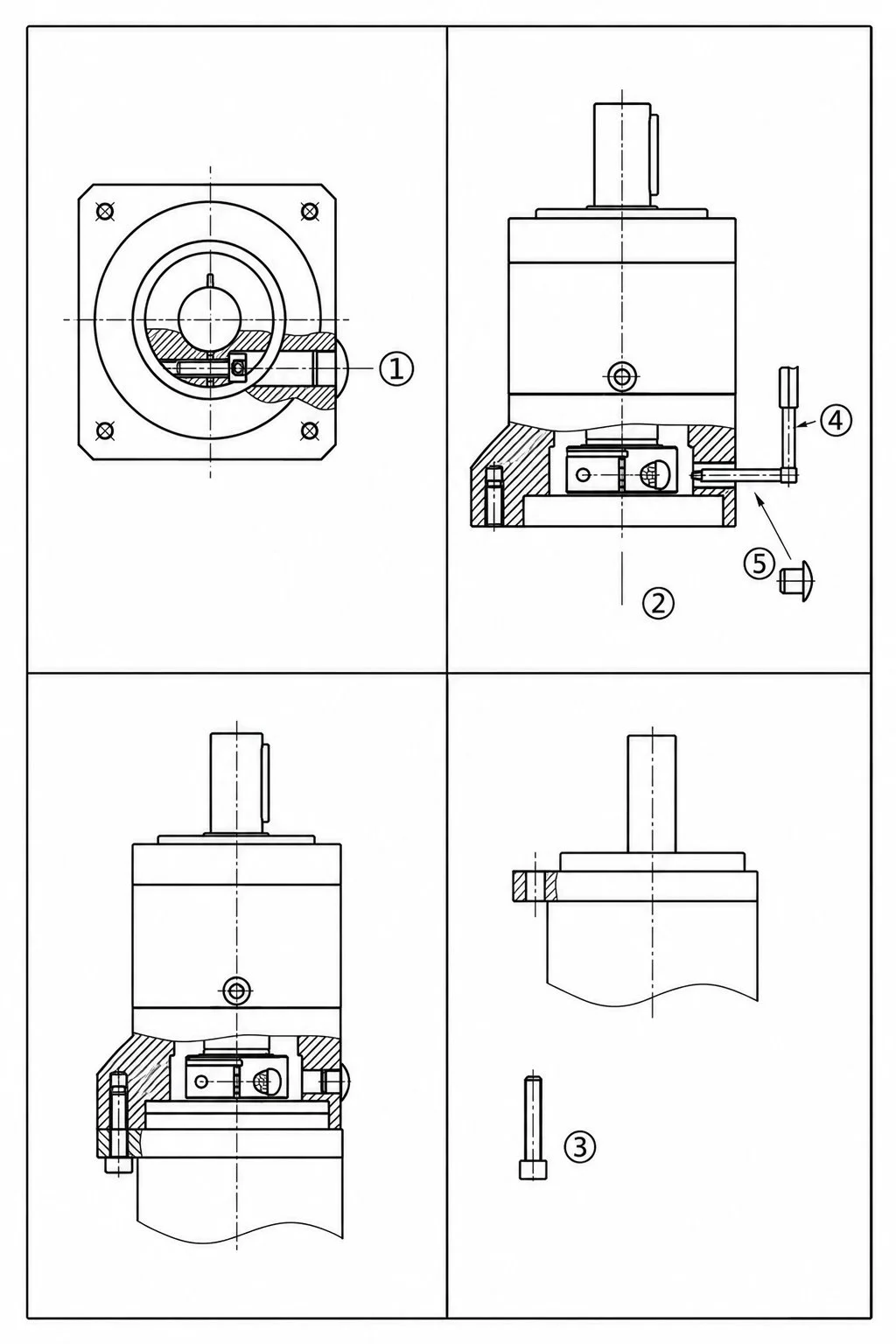
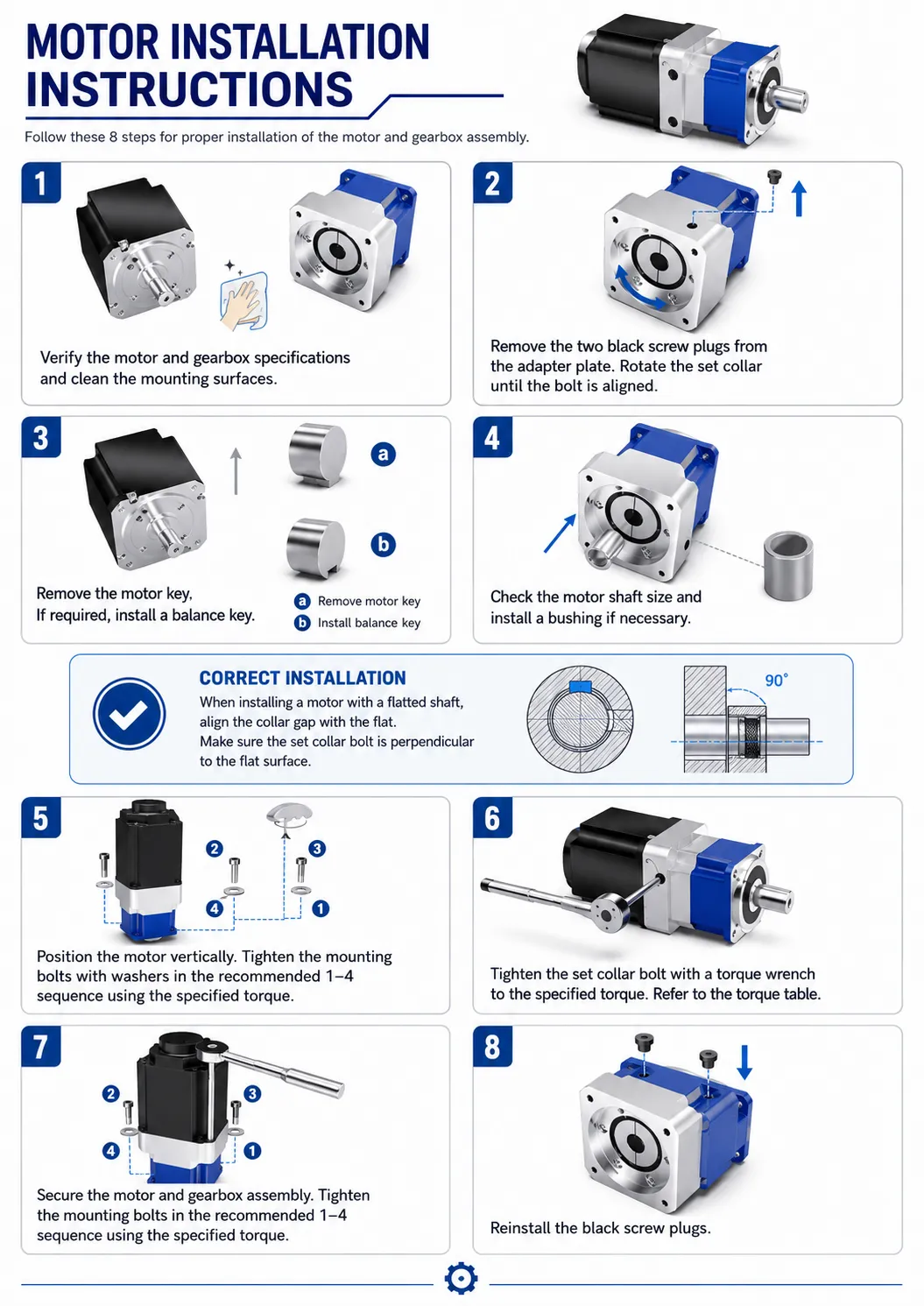
Everything else — housing cleaning, fastener torque checks, noise baseline recording, mounting alignment verification — is secondary but contributes to the complete annual inspection picture. The 12-point checklist in Module 4 captures all relevant inspection items in one printable document.
EP Series — What Maintenance Is and Is NOT Required
NOT required (sealed grease construction):
✗ Oil level checks or oil changes
✗ Vent plug cleaning or replacement
✗ Fill/drain port servicing
✗ Grease type specification
Required (annual):
✓ Shaft seal visual inspection (2 min)
✓ Housing temperature baseline (5 min)
✓ Mounting bolt torque check (5 min)
✓ Noise/vibration baseline (5 min)
✓ Coupling/shaft alignment verify (10 min)
Total annual inspection time: approximately 40 minutes per gearbox. In a 100-machine Korean factory: ~67 person-hours per year.
Backlash Measurement Procedure — Step-by-Step Field Protocol
Annual backlash measurement is the cornerstone of the planetary gearbox maintenance guide for any Korean precision servo application. The procedure requires no special tools beyond a dial gauge, a magnetic base, and a torque wrench — equipment available in virtually every Korean factory maintenance department.
De-energise and lock the drive system
Switch off power to the servo drive. Engage the motor holding brake (if fitted) or physically lock the motor shaft — a shaft clamp or wooden block prevents any input shaft rotation during measurement. Confirm zero energy state per your factory LOTO (lockout/tagout) procedure before approaching the gearbox output.
Mount the dial gauge at the output shaft
Attach the magnetic base to a fixed machine surface (not the gearbox housing). Position the dial gauge plunger tangentially against the output shaft flange or coupling at a known radius r from the shaft centreline. Record this radius — it is needed to convert the linear gauge reading to angular backlash in arcminutes: θ (arcmin) = (Δx / r) × (180 × 60 / π) = (Δx / r) × 3,438.
Apply light torque and zero the gauge
Apply a small torque (approximately 5% of rated torque) to the output shaft in one direction using a torque wrench on the output flange. This preloads the gear teeth against one set of flanks and eliminates any position uncertainty. Zero the dial gauge at this loaded position.
Reverse torque and read displacement
Apply the same small torque in the opposite direction. The gauge will move from zero to a new position. The total displacement Δx (mm) is the linear backlash at radius r. Convert to arcminutes using the formula in Step 2. Record the value and the measurement date.
Compare to delivery certificate and trend
Compare the measured value to the delivery certificate baseline (e.g. “0.82 arcmin, delivered 15 March 2023”). Record both in your maintenance log. If three consecutive annual measurements show a consistent upward trend, extrapolate to the 2× delivery value threshold — this is the predicted replacement date. For example: Year 1: 0.82′, Year 2: 1.05′, Year 3: 1.28′ → trend of +0.23’/yr → reach 1.64′ (2×) in Year 4.5 → plan replacement in Year 4 maintenance window.
Gauge Reading → Arcminute Conversion Reference
Formula: θ (arcmin) = (Δx ÷ r) × 3,438 · r in mm · Δx = total gauge travel from one side of backlash to the other
| Measurement radius r | Δx = 0.03 mm | Δx = 0.05 mm | Δx = 0.10 mm | Δx = 0.15 mm |
|---|---|---|---|---|
| r = 25 mm (small coupling) | 4.1′ | 6.9′ | 13.8′ | 20.6′ |
| r = 50 mm (100mm OD coupling) | 2.1′ | 3.4′ | 6.9′ | 10.3′ |
| r = 100 mm (flange / arm) | 1.0′ | 1.7′ | 3.4′ | 5.2′ |
| r = 150 mm (large flange) | 0.7′ | 1.1′ | 2.3′ | 3.4′ |
A 100 mm jaw-coupling OD gives r = 50 mm. At this radius, 1 arcmin = 0.029 mm of gauge travel — readable with a standard 0.01 mm dial gauge. Highlight the r = 50 mm row above for the most common Korean packaging and conveyor coupling size.
Grease Life Model — Predicting Service Life from Temperature, Speed, and Load
The standard 20,000-hour design life for Korea Ever-Power EP sealed grease assumes operation within rated parameters at the reference temperature. When actual operating conditions differ from the reference, grease life adjusts according to three variables: housing temperature, input speed, and applied torque as a fraction of rated torque.
Temperature factor (dominant): As established in the Arrhenius model (Art13), grease oxidation rate doubles for every 10°C above rated temperature. The grease life correction factor for temperature:
GREASE LIFE — THREE-VARIABLE MODEL
L_actual = L_base × f_T × f_n × f_L
f_T (temperature):
f_T = 2^((T_ref − T_actual)/10)
At T=70°C (ref): f_T = 1.0
At T=80°C: f_T = 0.5
At T=90°C: f_T = 0.25
f_n (speed, relative to rated):
At n = n_rated: f_n = 1.0
At n = 1.5×rated: f_n = 0.7
At n = 0.5×rated: f_n = 1.3
f_L (load, relative to rated):
At L = 100% T_rated: f_L = 1.0
At L = 70% T_rated: f_L = 1.25
At L = 130% T_rated: f_L = 0.7
Example — Korean summer packaging drive:
T=82°C, n=1.0×, L=90%
f_T=0.45, f_n=1.0, f_L=0.95
L = 20,000 × 0.45 × 1.0 × 0.95
= 8,550 hours (vs 20,000 rated)
This example illustrates a critical planning point for Korean food packaging facilities: a gearbox running at 82°C in summer conditions (typical for an uncooled packaging hall in August) has an actual grease life of 8,550 hours — not the 20,000 hours stated in the datasheet. At 6,300 operating hours per year in three-shift operation, this gearbox should be replaced at 16 months, not the 38 months implied by the rated life.
The practical application: measure housing temperature during peak summer operation (July–August) and apply the temperature correction factor to calculate the actual grease life for your specific installation. Then plan replacement accordingly — a 12-month notice period allows spare gearbox inventory to be organised without emergency procurement costs.

Grease Life at Different Operating Conditions (based on L_base = 20,000 h)
| Conditions | ज़िंदगी | 3-shift replace |
|---|---|---|
| T=65°C, 80% load | 26,000 h | 4.1 yr |
| T=70°C, 100% load (ref) | 20,000 h | 3.2 yr |
| T=80°C, 100% load | 10,000 h | 1.6 yr |
| T=82°C, 90% load (summer) | 8,550 h | 1.4 yr |
| T=90°C, 100% load | 5,000 h | 0.8 yr |
3-shift = 6,300 h/yr. Temperature is dominant variable — 10°C rise halves service life.
12-Point Annual Inspection Checklist — Printable Field Reference
Complete this inspection at each annual planned maintenance shutdown. This planetary gearbox maintenance guide inspection form records all values in one place. The quantified trigger values define the action: “Schedule replacement” = plan at next shutdown; “STOP” = take offline immediately.
Temperature, Noise, and Vibration — Establishing Baselines and Reading Warning Signs
The value of temperature, noise, and vibration measurements comes not from absolute values alone but from trending — how they change year-on-year at the same operating conditions. A gearbox at 73 dB(A) in Year 3 that was 68 dB(A) in Year 1 (same speed and load) has produced 5 dB(A) of noise growth signalling internal wear accumulation, regardless of whether 73 dB(A) exceeds any absolute limit.
To establish meaningful baselines, all measurements must be taken at consistent conditions. For Korean factories the recommended baseline protocol is:
- Temperature: Measure 30 minutes after startup at normal production load. Same season each year (spring; avoid summer extremes). Record ambient temperature alongside. Compare ΔT = housing − ambient year-over-year.
- Noise: Measure at 300 mm from the housing face at rated speed, no-load. Record the ambient background level. A consistent 5 dB(A) rise at the same conditions warrants investigation.
- Vibration: Mark the accelerometer position on the housing at first measurement. Measure axial and radial RMS velocity at the same spot each year. Impulsive spikes (5× RMS, short-duration) indicate a spalling bearing — treat as a STOP condition.
Short-duration high-amplitude vibration impulses (rather than a steady RMS increase) are the characteristic signature of a developing bearing raceway spall. Once spalling begins it propagates rapidly. If impulse events exceed 5× the baseline RMS, remove the gearbox from service at the earliest opportunity — do not wait for the next planned shutdown.

20–35°C normal · >45°C investigate · >65°C STOP
70–76 dB(A) new · +5 dB → schedule repl. · +10 dB → STOP
0.5–1.5 mm/s new · 2× baseline → schedule · 5× or impulses → STOP
<80°C safe · 80–90°C warning · >90°C grease limit exceeded
Record your own first-year baseline — your installation conditions determine your actual reference values. Use the above as a starting guide only.
Series-Specific Maintenance Considerations
EP-AB / EP-AF Precision Series
12-point checklist applicable in full. Annual backlash measurement is the critical activity — P0/P1/P2 grade loss is the primary aging indicator. Sealed grease: no re-lubrication. Replace when backlash reaches 2× delivery certificate or temperature-corrected grease life is reached. Delivery certificate backlash value is key reference — keep it in the maintenance file.
EP-AFH Ultra-Precision
Same 12-point checklist. Backlash threshold is tighter — the delivery certificate value is ≤1 arcmin; schedule replacement at 1.5 arcmin and stop at 2.0 arcmin. Electronics and semiconductor applications are particularly sensitive to any noise increase — a 3 dB increase in noise at a specific frequency may indicate a developing bearing issue requiring earlier inspection.
EP-KF/KH Hypoid Series ⚠ 0°C min
Additional maintenance note: confirm the installation temperature has remained above 0°C throughout operation since last inspection. Cold-temperature churning produces abnormal wear not captured in standard backlash measurement. If the facility has experienced temperatures approaching 0°C, inspect for noise increase that indicates hypoid gear surface wear from cold-oil viscosity overload. Consider relocating the gearbox or installing heated enclosure if temperature drops below 5°C at any time.
EP-BPG Energy-Saving (Worm Replacement)
Sealed grease — same as standard EP-AB. Additional check at first annual inspection: confirm no service factor under-specification has occurred post-installation. Worm replacement with EP-BPG sometimes reveals that the worm was oversized for its actual load — confirm the BPG is not running at above 90% rated torque continuously, which would trigger the SF re-calculation described in Art11.
EP-AH New Line Heavy-Duty
Heavy-duty series at high continuous torque applications (conveyor, crane, solar tracker). Check mounting bolt torque more frequently — every 6 months rather than annually — for installations subject to vibration, shock, or outdoor thermal cycling. The structural housing of the New Line series provides higher mounting stiffness than standard EP-AB, but fastener preload can still relax over time under sustained vibration.
Replacement Planning — Lead Times and Spare Parts Management in Korea
Planetary gearbox replacement in Korean industry is complicated by the same factor that drives the annual inspection protocol: the gearbox typically fails — or approaches replacement condition — at an inconvenient time relative to planned maintenance shutdowns. A Korean packaging line that shuts down for annual maintenance in January may find in October that its cross-seal jaw gearbox backlash has reached the 1.5× trigger value. Without a stocked spare, the replacement cannot be scheduled for October — the machine runs with degraded performance until January, and the gearbox may fail between October and January.
Korea Ever-Power stock availability: Standard EP-AB, EP-AF, and EP-BPG frame sizes in the most common ratios (i=5, 10, 25, 50, 100) and grades (P0, P1, P2) are held in Korea Ever-Power’s Korean warehouse for same-week delivery. Non-standard ratios, large frames (above 200 mm body size), and special options (IP67, cleanroom grease, matched pairs) require 2–4 weeks production lead time. Planning replacement 3–6 months in advance — indicated by the 1.5× backlash trigger value — allows standard units to be pre-ordered for the planned replacement window without emergency premium.
For factories with more than 5 identical gearbox installations (same model, ratio, and grade), stock one spare unit for same-day replacement capability. The inventory cost of one spare gearbox is typically recovered within the first avoided emergency shutdown. For factories with many different gearbox specifications, the annual inspection protocol enables a 12-month planned replacement forecast — eliminate emergency procurement entirely by pre-ordering identified replacement units at the prior annual inspection.
Korea Ever-Power Delivery Lead Times

Korea Ever-Power EP Series — Planetary Gearbox Maintenance Guide Calendar
| Interval | Activity | Time Req. | शृंखला | Tools Required |
|---|---|---|---|---|
| Monthly | Shaft seal visual inspection | 2 min | All EP series | None — visual only |
| Monthly | Abnormal noise check during operation | 1 min | All EP series | None — aural inspection |
| 6 months | Mounting bolt torque check | 5 min | AH New Line, outdoor, high-vibration | Torque wrench |
| Annual ★ | Full 12-point inspection (Module 4) | 40 min | All EP series | Dial gauge, IR thermometer, torque wrench |
| Annual ★ | Backlash measurement and log | 10 min | All precision series (AB, AF, AFH) | Dial gauge, delivery certificate |
| Annual ★ | Temperature baseline record (summer) | 5 min | All EP series | IR thermometer |
| At 15,000 h | Order replacement unit (standard stock) | — | All EP series (adjust for T-corrected life) | Korea Ever-Power order |
| At 20,000 h or backlash 2× | Replace gearbox at next planned shutdown | 2–4 h | All EP series | Standard installation tools |
Frequently Asked Questions — Planetary Gearbox Maintenance
Korea Ever-Power Maintenance Support — Delivery Certificates and Service Records
Every Korea Ever-Power EP precision series delivery includes a backlash certificate with the measured value — the foundation of your annual inspection programme. Korea Ever-Power also provides Korean-language maintenance schedule templates and replacement planning consultation for Korean industrial facilities.
संपादक: सीएक्सएम