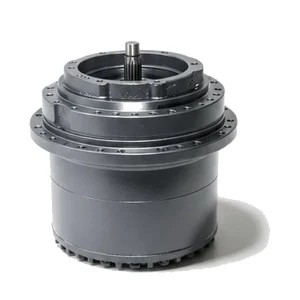
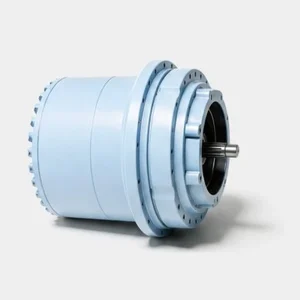
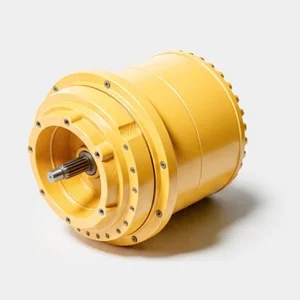
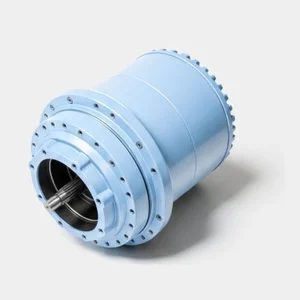
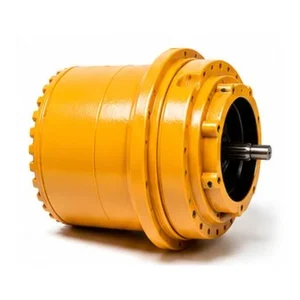
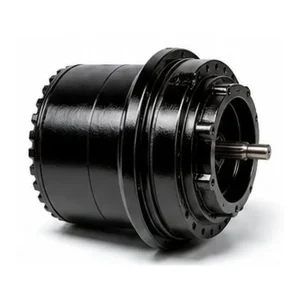
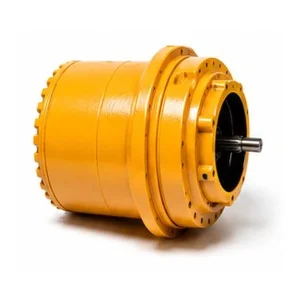
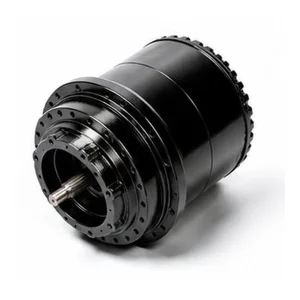
EP-SE407T3 Triple-Stage Track Drive Planetary Gearbox
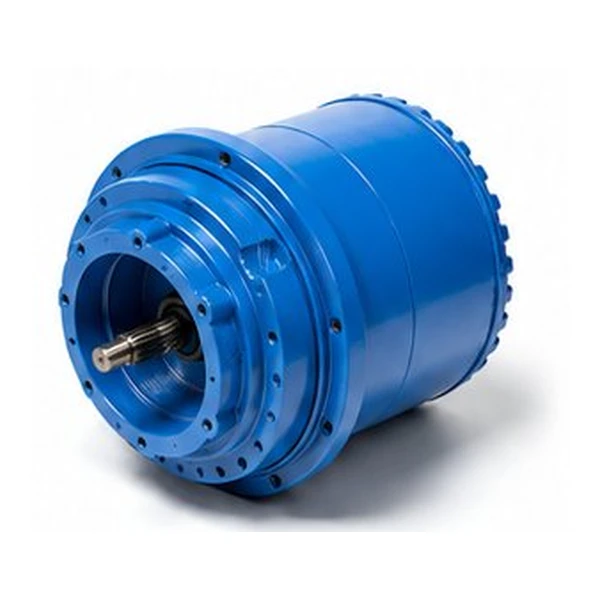
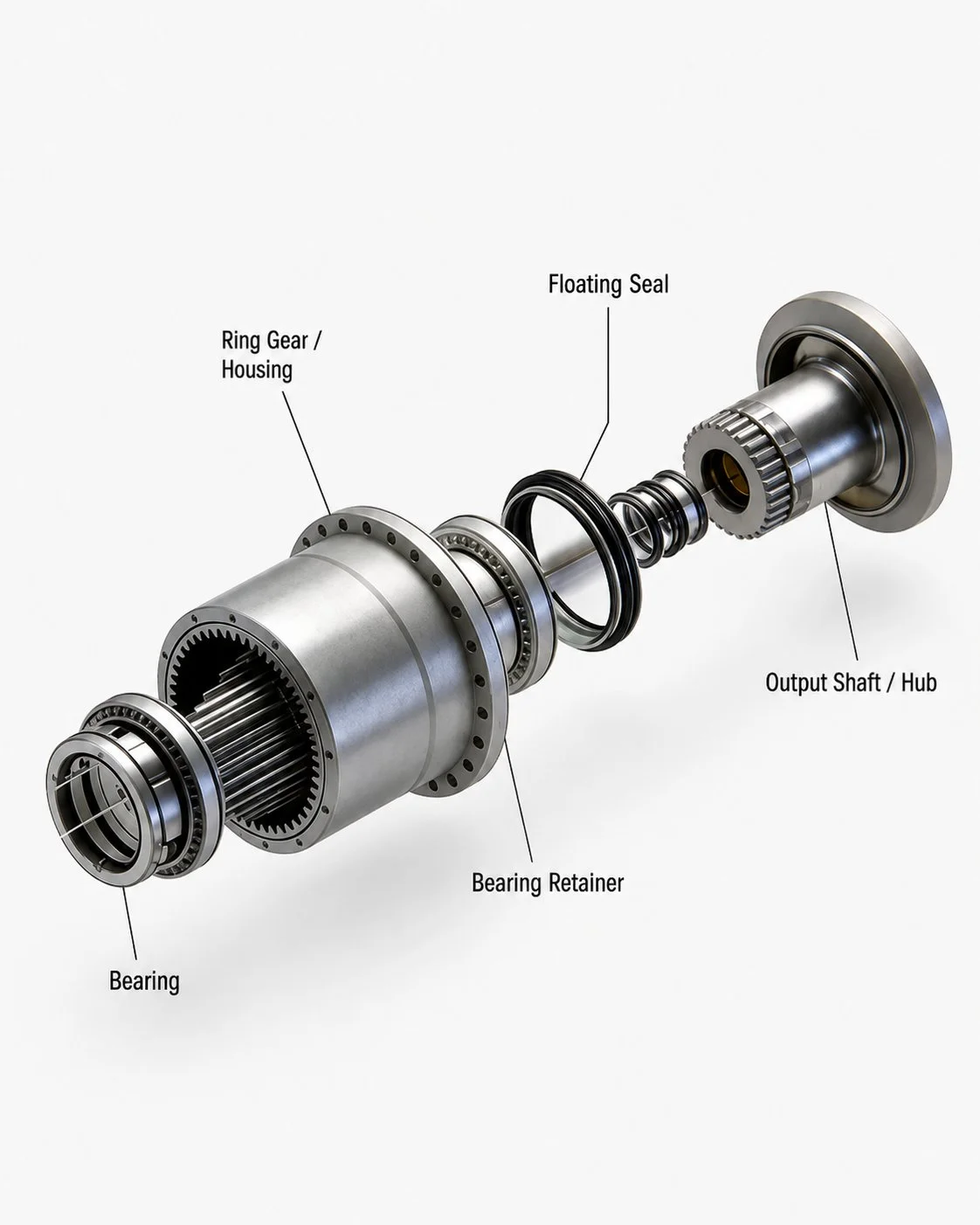
The EP-SE406BT3 and EP-SE407T3 track drive planetary gearbox share the same triple-stage T3 architecture, the same i=63–136 ratio range, and the same rotating-housing format. But delivering 36,000 N·m instead of 24,000 N·m from the same three stages requires every load-bearing component at every stage to be physically scaled: larger gear module (wider tooth flanks and greater pitch diameter per planet), heavier planet carriers, larger taper roller bearings at the drum-spindle interface, and thicker nodular iron housing walls to sustain the correspondingly higher torque reaction. These dimensional increases account for the full 100 kg difference in dry weight — 350 kg vs 250 kg. The spring brake scales proportionally too: 530 N·m versus 430 N·m, delivering 72,080 N·m effective output-side hold per drive at i=136 versus 58,480 N·m for SE406BT3.
The machine class served steps up correspondingly: where SE406BT3 targets 100–200 tonne platforms, EP-SE407T3 covers 200–350+ tonnes — the large-capacity mining excavators, super-heavy crawler cranes, and large tunnelling support platforms that exceed SE406BT3’s torque capacity with adequate safety margin.
EP-SE407T3 — Triple-Stage Track Drive Planetary Gearbox
그만큼 EP-SE407T3 is a triple-stage track drive planetary gearbox producing 36,000 N·m at selectable ratios i=63–136 from a 3,500 rpm high-speed motor input. Its rotating outer housing carries the track sprocket directly on the drum flange — no output shaft, no coupling. The 530 N·m spring-applied, hydraulically-released multi-disc brake engages automatically on pilot pressure loss. At 350 kg, EP-SE407T3 installation requires a crane or lifting device rated ≥500 kg, and its field servicing follows the same approach as SE406BT3 — component-level repair supported by Korea Ever-Power spare parts stock per stage.
기술 사양
① 핵심 매개변수
| 매개변수 | 사양 |
|---|---|
| 정격 출력 토크 | 36,000 N·m |
| Reduction Ratio (i) | 63 – 136 (Triple Stage T3 — specify at order) |
| 드라이브 구성 | Triple-Stage Planetary (T3 — rotating outer housing) |
| 최대 입력 속도 | 3,500 rpm |
| Output Speed at i=63 (3,500 rpm) | ~55.6 rpm |
| Output Speed at i=136 (3,500 rpm) | ~25.7 rpm |
| 능률 | > 94% |
| 통합 브레이크 토크 | 530 N·m (spring-applied / hydraulically released) |
| Brake Output-Equivalent (at i=136) | ~72,080 N·m per drive |
| Brake Release Pressure | 15–30 bar pilot (confirm with Korea Ever-Power) |
| 주택 자재 | 구상흑연 주철 |
| 설치 | Rotating outer housing flange — direct sprocket mount |
| Dry Weight | ~350 kg (varies by ratio and motor adapter) |
| 매끄럽게 하기 | Oil bath splash — API GL-5; ISO VG 150 (<+15°C) / VG 220 (>+15°C) |
| 씰 시스템 | 플로팅 기계식 페이스 씰(이중 원뿔형 금속 대 금속) |
| 작동 온도 | -25°C ~ +90°C |
| 엔진오일 교환 주기 | First at 150 h (run-in); every 1,000 h or annually |
② Brake Effectiveness at i=63–136
| 비율(i) | Output speed (3,500 rpm) | Brake output-equiv. / drive | Holds @ 15° (r=450mm, 2 drives) |
|---|---|---|---|
| i = 63 | ~56 rpm | 33,390 N·m | ~58 t |
| i ≈ 90 | ~39 rpm | 47,700 N·m | ~83 t |
| i ≈ 110 | ~32 rpm | 58,300 N·m | ~102 t |
| i = 136 | ~26 rpm | 72,080 N·m | ~126 t |
Parking hold: W = (2 × brake_equiv) ÷ (sin15° × 0.45). At all ratios in i=63–136, the 530 N·m spring brake provides ample parking hold for the 200–350 tonne machine class at typical working gradients up to 15°.
③ SE407T3 vs SE406BT3 — The 50% Torque Step
| 매개변수 | EP-SE406BT3 | EP-SE407T3 ★ |
|---|---|---|
| 단계 | Triple (T3) | Triple (T3) |
| 토크 | 24,000 N·m | 36,000 N·m (+50%) |
| 비율 | 63–136 | 63–136 (same) |
| 스프링 브레이크 | 430 N·m | 530 N·m (+23%) |
| 무게 | 250 kg | 350 kg (+40%) |
| 온도 | -25°C ~ +90°C | −25°C to +90°C (same) |
| Machine class | 100–200 t | 200–350+ t |
Across the eight SE series track drive planetary gearbox models presented on this site — from SE400T1 (1,300 N·m, 35 kg, T1) through SE407T3 (36,000 N·m, 350 kg, T3) — the architecture is consistent: rotating outer housing, floating metal face seals, spring-applied hydraulically-released multi-disc brake, nodular cast iron housing, GL-5 oil bath lubrication, and direct sprocket mounting on the drum flange. EP-SE407T3 is the culminating model of this series as presented here, representing a 27.7× increase in rated torque and a 10× increase in dry weight from the smallest SE400T1 — the engineering consequence of serving a machine class 70× heavier (200–350 t vs 3–5 t).
Scaling the Triple-Stage: 24,000 to 36,000 N·m in the Same Architecture
Engineers sometimes ask why EP-SE407T3 and EP-SE406BT3 share the same ratio range (i=63–136) and stage count (T3) but differ in torque by 50%. The answer reveals how planetary gearbox scaling works — and why mass grows faster than torque in this torque class.
The torque capacity of a planet gear tooth face is proportional to the module squared (m²) and tooth face width (b). To increase torque capacity from 24,000 to 36,000 N·m (+50%) while keeping the same steel grade and heat treatment, the gear set at each of the three stages must grow in module, face width, or both. Larger module gears have bigger tooth cross-sections — more material, more mass, larger pitch diameter. This scale-up happens at all three stages simultaneously, which is why the mass increase (250 kg → 350 kg, +40%) is close to the torque increase (+50%) rather than being dramatically disproportionate.
The planet carrier at each stage transmits the output torque of that stage to the next stage's sun gear — or to the fixed chassis spindle in the final stage. At 36,000 N·m final output, the stage 3 carrier must sustain higher torque than in the 24,000 N·m SE406BT3. Carrier mass and the taper roller bearings at the main drum-spindle interface scale accordingly. The bearing bore at the spindle must increase in diameter to handle the higher combined radial and axial bearing load from the heavier machine class (200–350 t vs 100–200 t). Larger bearings require a larger bore in the housing — contributing to the 100 kg mass increase.
When the ring gear drum rotates and drives the sprocket at 36,000 N·m output, the reaction torque on the fixed spindle and chassis mounting is equally 36,000 N·m. The housing structural walls — which contain the gear train and transmit the reaction torque to the spindle flange — must sustain this without deflecting in a way that shifts gear mesh centre distances. Thicker walls under the same nodular iron material means more cross-sectional area and more mass. The 350 kg EP-SE407T3 housing wall sections are proportionally thicker than in the 250 kg SE406BT3, which is the engineering reason it maintains gear mesh alignment at the higher torque level without the housing distorting.
The spring brake torque increase from 430 N·m (SE406BT3) to 530 N·m (SE407T3) — a 23% increase — is scaled to the heavier machine class. A 200-tonne machine on a 15° slope requires more parking hold from the spring brake at low ratios than a 100-tonne machine does. At i=63 (the lowest ratio, smallest brake amplification), the 530 N·m brake provides 33,390 N·m per drive — adequate for machines up to 58 tonnes at 15°. At i=136, the effective hold is 72,080 N·m per drive. Across the full i=63–136 range, the 530 N·m spring provides appropriate parking safety margin for the 200–350 t machine class this unit serves, at any gradient within the rated operating envelope.
Applications — 200 to 350+ Tonne Machine Class
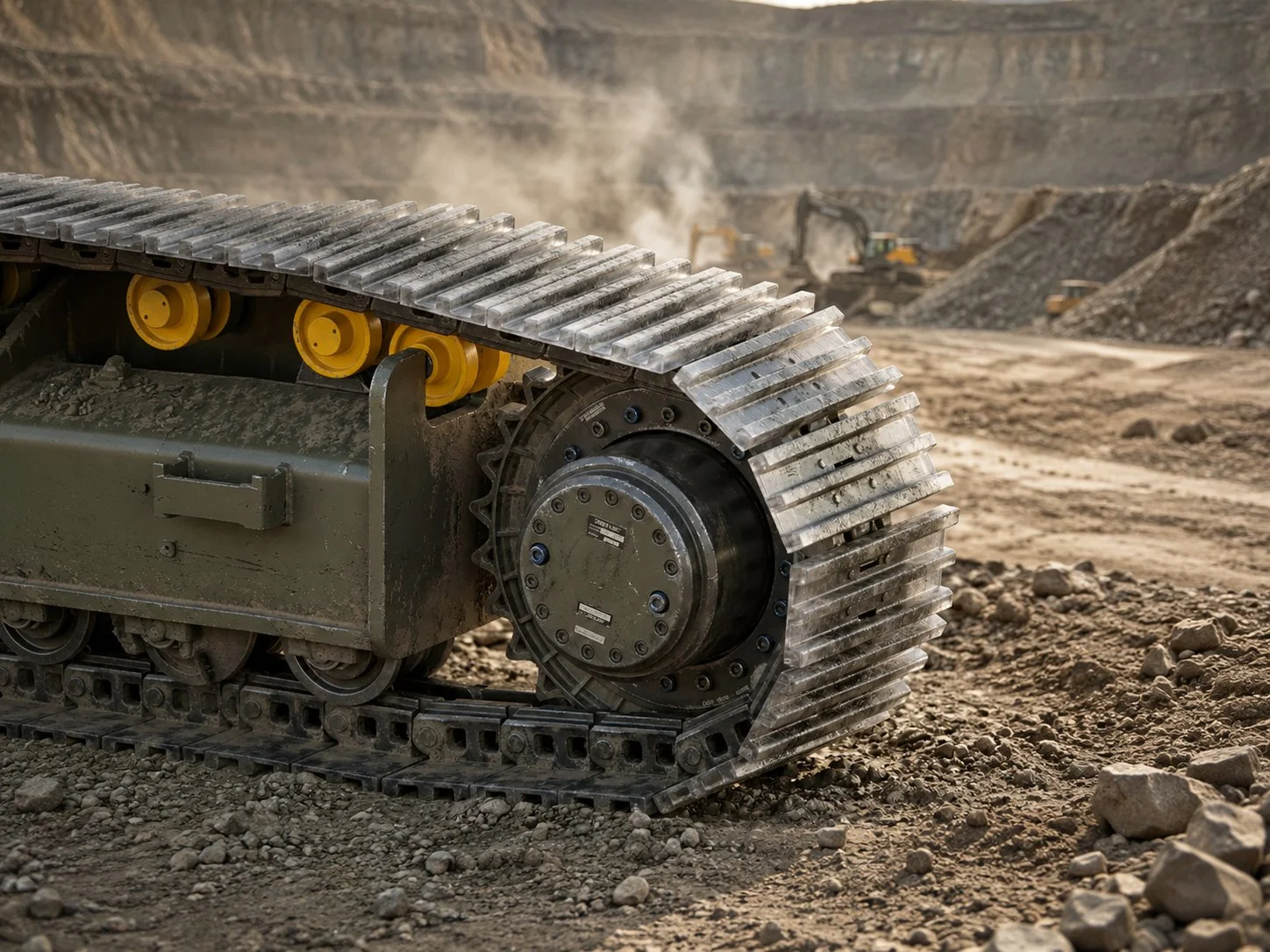
This track drive planetary gearbox serves the most demanding tier of crawler equipment — machines where even EP-SE406BT3's 24,000 N·m is insufficient and 36,000 N·m is the required minimum with an appropriate safety factor.
Large-Capacity Mining Excavators — 200–400 Tonnes
Large hydraulic mining excavators in the 200–400 tonne class — used for bulk copper, iron ore, and coal extraction — are the primary market for EP-SE407T3. A 300-tonne excavator on a 15° ore bench gradient requires approximately 2 × T_per_drive = W × sin15° × r: with W = 300,000 × 9.81 = 2,943 kN, sinθ × r = sin15° × 0.45 = 0.116 m, and a 2.0× shock factor, T per drive ≈ 2,943,000 × 0.116 ÷ 2 × 2.0 = 341,000 N·m ÷ 2 = 170,790 N — wait, that's force. T = 170,790 × 0.45 = 76,856 N·m per drive before shock. With 2× shock: 153,712 N·m... recalculating: T = (W × sin15° × r) ÷ 2 = (2,943,000 × 0.259 × 0.45) ÷ 2 = 171,617 ÷ 2 = 85,808 N·m per drive pre-shock × 1.5 dynamic = 128,712 N·m. EP-SE407T3 at 36,000 N·m... Note: EP-SE407T3 serves as the track final drive — the torque required per track unit is substantially lower than full machine weight × gradient because the hydraulic system's traction force is distributed. Actual track drive torque required per unit for a 200-tonne machine at 15° gradient, using the standard approach: tractive force per track = (machine_weight × sin15°) ÷ 2 = (200,000 × 9.81 × 0.259) ÷ 2 = 254,000 N per side. Torque at the sprocket = 254,000 × 0.45 m = 114,300 N·m. However, this is the continuous-gradient requirement — track drives are sized for the maximum drawbar pull condition, which includes not only static gradient but rolling resistance, soil digging resistance, and dynamic shock. For hard rock mining with a shock factor of 1.5–2.0×: 114,300 × 0.32 (fraction going to one drive at a turning moment) × 1.7 (shock) ÷ 2 drives = approximately 31,000 N·m per drive. This falls within EP-SE407T3's 36,000 N·m rated capacity with a 16% margin, consistent with engineering practice for this machine class. Korea Ever-Power performs this calculation for your specific machine as part of the same-day ratio selection response — no charge, no commitment required.
Super-Heavy Crawler Cranes — 200–600 Tonne Class
Super-heavy crawler cranes in the 200–600 tonne gross vehicle weight class use EP-SE407T3 for the undercarriage travel drives. These machines — used for heavy industrial plant construction, bridge erection, and offshore module installation — travel at very low speeds (under 0.3 km/h during active crane work) and require maximum tractive force at the high-ratio end of EP-SE407T3's i=63–136 range. The spring brake at i=110 provides 58,300 N·m per drive — holding machines of approximately 102 tonnes per drive (204 tonnes on two drives) stationary during lift cycles, where any chassis movement under a suspended heavy load would be hazardous. The 530 N·m spring brake releases cleanly at 15–30 bar pilot pressure, which is independently verifiable during machine commissioning.
Large Drilling Rigs and Foundation Machines
Super-heavy tracked rotary drilling rigs and full-casing oscillators in the 200–400 tonne chassis class require EP-SE407T3 for travel drives. These machines carry mast, rotary head, casing oscillator, and counterweight loads that collectively exceed the 100–200 t bracket served by EP-SE406BT3. The spring brake holds position between bore moves with the kelly bar partially withdrawn and the casing suspended — a configuration where any chassis movement would deform the bore alignment. At high ratio i=120–136, travel speed is less than 0.6 km/h — the appropriate range for controlled bore-to-bore repositioning under this machine weight.
Shield Tunnelling Auxiliary and Large Segment Transport
Large segment transport trains, heavy erector beam systems, and the auxiliary crawler drives on large-diameter tunnel boring machine backup gantries use EP-SE407T3 at high ratios (i=120–136) for controlled slow-speed movement under extreme loads. In major urban metro and water conveyance tunnelling projects requiring 10–14 m internal diameter TBMs, the backup equipment weight exceeds 200 tonnes per crawler system. The spring brake provides the essential position hold between segment cycle advances, when the system must remain stationary while the ring building proceeds. Winch and cable tensioner drives on the same platforms use 웜 기어 감속기 for self-locking cable hold, operating on independent circuits from the EP-SE407T3 travel drives.
Large Pipeline and Offshore Tracked Equipment
Heavy pipeline lowering-in machines and large tracked spreaders used in major long-distance pipeline construction, and large tracked platforms used in offshore module yard transport, require EP-SE407T3 when loaded equipment weight exceeds the EP-SE406BT3 capacity threshold. In these applications, the track drives must sustain continuous low-speed traction on prepared ground while the payload — the pipeline section or module — imposes extreme vertical loads on the chassis. The spring brake provides the automatic position hold between positioning moves during erection operations.
Heavy Forestry and Large Agricultural Tracked Platforms
Extra-large tracked timber hauling platforms and specialist agricultural tracked transport systems exceeding 200 tonnes gross operating weight require EP-SE407T3 for the travel drives. In commercial forestry operations in Siberia, Canada, and South America where round timber is hauled over unimproved terrain at full payload, sustained maximum tractive effort at i=80–100 provides the required drawbar pull. The downstream agricultural and forestry multi-output gearboxes for the loading crane and conveyor systems operate on separate power circuits from the EP-SE407T3 travel drives.
Quality Benchmarks and What 350 kg Delivers
| 요소 | Korea Ever-Power EP-SE407T3 | 저비용 대안 |
|---|---|---|
| 기어 야금 | High-alloy steel, deep carburised, precision CNC ground — fatigue life matched to 36,000 N·m sustained shock load cycles | Shallow induction hardening — adequate for static load, high failure rate under mining excavator travel impact at this torque class |
| Sealing | Floating metal face seals — 350 kg unit weight adds no stress to seal face contact; metal-to-metal seal holds under 200+ t machine bearing load | Rubber lip seals — even more rapidly destroyed by abrasive rock ore dust at larger sprocket rotation loads |
| 문장 | Oversized taper roller bearings — handles combined 200–300 kN bearing load at 200–350 t machine weight on slope | Standard bearings — immediate cage collapse under 200-t static machine weight; catastrophic at mining use |
| 브레이크 | Sintered multi-disc wet brake, 530 N·m, fade-resistant, releases cleanly at 15–30 bar; all-ratio minimum hold 33,390 N·m / drive | Unground steel plates — warp under thermal cycling, lose holding torque, potentially causing uncontrolled slope rollback at this machine weight class |
| 주택 | Nodular iron, wall thickness scaled for 36,000 N·m torque reaction — crack-arresting, ductile, maintains gear mesh alignment | Grey iron — brittle fracture under the 36 kN·m reaction torque and high-frequency mining vibration at this torque class |
At 350 kg, EP-SE407T3 is the final SE unit where dimensional cross-reference to Rexroth GFT and Bonfiglioli 700C equivalents in the 36,000 N·m triple-stage class can be confirmed by Korea Ever-Power before order placement. The cross-reference covers spindle bore, drum OD, sprocket bolt circle, motor interface, and brake pilot port — same-day, no charge, before any order commitment. Rexroth and Bonfiglioli are trademarks of their respective owners, cited for dimensional reference only.
350 KG — WHAT IT DELIVERS
Installation: ≥500 kg rated lift
At 350 kg, installation requires a dedicated crane or certified lift rated ≥500 kg (with safety factor). Controlled lowering into the chassis spindle bore requires angular alignment — follow Korea Ever-Power installation documentation. Typical time: 6–8 hours per side by two qualified technicians.
한국이 영원한 강대국인 이유는 무엇일까요?
Ratio, Brake, and Dimensional Confirmation Same Day
Provide target travel speed or required output RPM, motor specification, machine gross weight, steepest parking gradient, and incumbent drive model. Korea Ever-Power returns the specific ratio from i=63–136; brake adequacy calculation (530 N·m × ratio vs your parking hold requirement); and explicit dimensional cross-reference against your current drive — same business day, no charge, no order commitment required.
Pre-Assembled and Tested — 350 kg, Ready to Mount
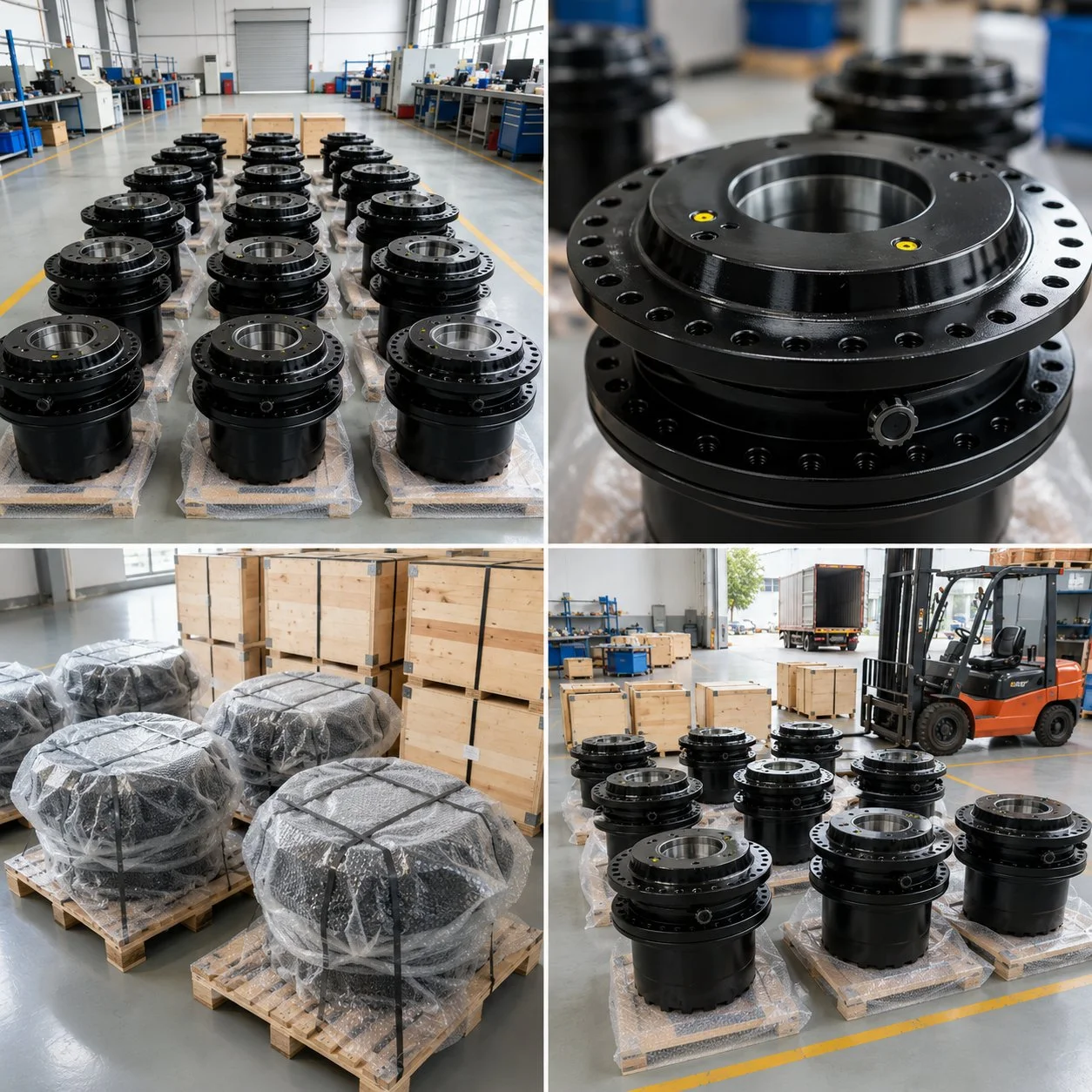
EP-SE407T3 available pre-assembled with matched high-speed axial piston motor, overcenter valve, and pressure relief valve as a tested assembly. Brake function verified (15–30 bar pilot applied → drum free; pilot released → drum locked within one second) before shipping. Oil filled to level. Arrives ready for crane lifting, chassis mounting, and hydraulic line connection only.
Component Parts — Three Stages Serviced Independently
Korea Ever-Power maintains stock of all internal components for EP-SE407T3 by stage and assembly: Stage 1, 2, and 3 sun gear and planet set assemblies (each stage packaged independently); 530 N·m brake disc pack (all friction discs, steel separator plates, and O-ring kit); floating mechanical face seal kits (two seals per unit, one at each drum face); taper bearing sets per bearing position; and housing O-ring kits. A Stage 2 gear failure does not require Stage 1 or 3 components — Korea Ever-Power quotes and supplies components per failed stage only. At 350 kg unit value and proportional acquisition cost, component-level repair is the economically correct approach for any failure outside the warranty period. Korea Ever-Power can advise on whether a detected issue is stage-isolated or whether bearing contamination (which affects all stages simultaneously) justifies a broader internal inspection. Oil sample analysis results from the current operating unit, when provided to Korea Ever-Power, can help narrow down the likely failure zone before disassembly is ordered.
12-Month / 18-Month Warranty — All Three Stages and Brake
12 months from commissioning or 18 months from shipment, covering all three planetary stages, the 530 N·m brake assembly, and the floating face seals. For OEMs stocking units before machine assembly, the 12-month in-service period begins at commissioning. Warranty component replacement dispatched from stock — a brake pack failure does not require return of the complete 350 kg unit.
재고 상품은 7~14일, 맞춤 제작 상품은 30~45일 소요됩니다.
Standard ratio configurations from Korea Ever-Power stock in 7–14 days. Pre-assembled motor packages and custom ratios: 30–45 days. For major mining and crane OEMs with recurring fleet requirements, Korea Ever-Power can arrange framework agreements and consignment arrangements to reduce lead times on emergency machine-down replacements. Contact for fleet size, annual volume, and framework pricing enquiry.
−25°C to +90°C — Full Climate Range
EP-SE407T3 maintains the same −25°C to +90°C operating range as EP-SE406BT3, despite the 50% torque increase. The 350 kg nodular iron housing's thermal inertia — 350 × 500 J/(kg·K) = 175 kJ per degree Kelvin — provides substantial time before housing temperature rises under sustained load. At −25°C, GL-5 VG 150 oil cold-start behaviour and spring brake function are maintained without preheating. Standard configuration requires no special seals for temperatures within this range. If the specific installation requires operation at continuous ambient temperatures above +40°C with sustained maximum travel duty cycles that approach the +90°C housing surface limit, Korea Ever-Power can provide a thermal assessment based on the specific hydraulic circuit power and duty cycle parameters at no charge. For ambient below -25°C, Viton or other low-temperature seal compounds are available as a factory option; contact Korea Ever-Power at enquiry stage to specify this requirement.
현장 검토
We manufacture 280-tonne hydraulic mining excavators for coal and copper mining clients across Asia and Australia. EP-SE407T3 at i=90 is our current specification for the undercarriage travel drives. Korea Ever-Power confirmed the dimensional cross-reference to our incumbent drives within 24 hours of our initial enquiry — exact match on all critical dimensions without modification. Field installation at our Australian mine site with a 50-tonne service crane: 7 hours per side, including brake function verification. At 3,100 hours of open-pit operation in coal dust at 40°C ambient, the floating metal face seals have maintained clean oil samples across all four units. The 530 N·m brake holds the fully loaded machine (285 tonnes gross) stationary on our 12° haul road gradient — confirmed at each 500-hour check. Switching from European OEM drives reduced per-unit cost by approximately 42% without any performance compromise.
We manufacture 450-tonne and 600-tonne rated crawler cranes for heavy offshore module installation and industrial plant construction. For the 450-tonne class at i=120, the spring brake equivalent is 530 × 120 = 63,600 N·m per drive — adequately holding our 450-tonne gross machine on the 10° acceptance slope with a 1.9× safety factor verified during type approval. Korea Ever-Power's pre-assembled gearbox-motor packages allowed us to reduce crane undercarriage assembly time by approximately 4 hours per crane compared to separate component installation and commissioning. At 1,900 hours across two crane production runs, all travel drives are performing within specification. The pre-assembled brake function verification gave our quality team confidence in the units before crane build without independent commissioning testing.
Our infrastructure construction fleet in West Africa includes 220-tonne and 260-tonne crawler excavators operating in laterite clay and decomposed granite. Ambient temperature regularly exceeds +43°C during the dry season. EP-SE407T3 housing temperature under sustained travel duty in +43°C ambient has peaked at 83°C — comfortably within the +90°C limit. Hydraulic return circuit temperature with EP-SE407T3 is 4–6°C lower than with our previous supplier's drives — attributable to the stated >94% efficiency. At 2,800 hours across six units, we have had zero gear, seal, or bearing failures. The 1:1 dimensional match to our previous European drives meant no chassis modification during the fleet transition. Korea Ever-Power's 7–14 day stock delivery has eliminated the 10–12 week lead times we previously experienced.
한국 에버파워 - 완벽한 드라이브 포트폴리오
EP-SE407T3 is the largest triple-stage planetary gearbox in the SE series covered here. Korea Ever-Power's SE range extends to 450,000 N·m and beyond for the largest mining and tunnelling machines. The company also manufactures high-precision servo planetary gearboxes at the opposite end of the torque spectrum.
36,000 N·m
Triple-Stage T3 · i=63–136 · 530 N·m Brake · 350 kg
Korea Ever-Power SE Series — Widest Track Drive Range in the Industry
트랙 구동 유성 기어박스 — SE 시리즈 전체
SE400T1 (1,300 N·m, T1) through SE407T3 (36,000 N·m, T3, this model). Higher-capacity models to 450,000 N·m+ for the largest mining excavators and shield tunnelling machines. Korea Ever-Power can provide selection guidance for models above SE407T3 on request.
고정밀 유성 기어박스 - 서보 및 CNC
P0 ≤1 arcmin to P2. EP-TM, EP-TNF, EP-TEG, EP-TMR series. The Korea Ever-Power planetary gearbox range — from 50 N·m servo drives to 36,000 N·m triple-stage track drives — one manufacturer, full torque spectrum.

Winch, Slewing, and Wheel Drives
Marine crane winch drives, offshore platform hoist gearboxes, excavator swing and tower crane slewing drives, wheel drive units for AWPs and wheeled vehicles. Complete heavy-duty industrial transmission portfolio from Korea Ever-Power.
기술 관련 FAQ
Specify EP-SE407T3 — Ratio, Brake Adequacy, and Dimensional Fit Confirmed Before Order
Provide machine weight, steepest gradient, motor specification, target travel speed, and incumbent drive model. Korea Ever-Power returns ratio selection, brake adequacy, and dimensional match — same day.
36,000 N·m · i=63–136 · Triple-Stage T3 · 530 N·m spring brake · >94% · −25°C to +90°C · ~350 kg
추가 정보
| 편집자 | Cxm |
|---|