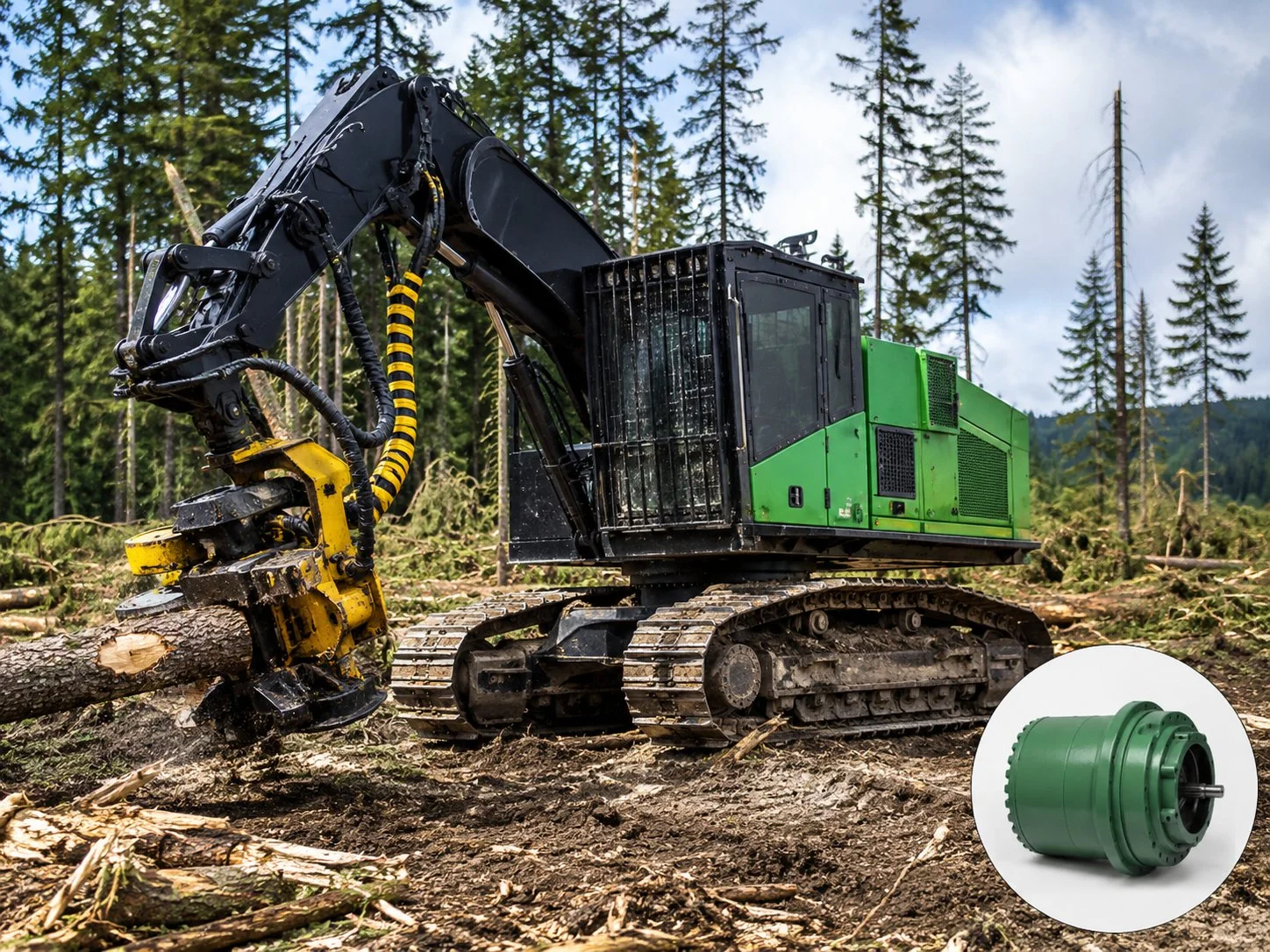
The Forestry Environment — Four Challenges That No Other Track Drive Application Faces Simultaneously
A construction-site excavator operates on cleared, graded ground. A mining bulldozer works on engineered benches. A feller buncher works on the ground as it exists — uncleared, ungraded, littered with debris, and often tilted at angles that would violate safety regulations on any construction site. The track drive planetary gearbox that operates in this environment must survive challenges that no other final drive faces.
Feller bunchers routinely work on slopes of 30 to 40 degrees — gradients that no excavator, bulldozer, or dump truck would attempt. Some specialised steep-slope machines operate up to 45 degrees (100% grade). At 40 degrees, the gravitational force component pulling the machine downhill is 64% of the machine weight. The track drive must hold this force continuously — and propel the machine uphill against it when repositioning between trees.
The machine drives over exposed roots, buried stumps, and fallen timber with every track revolution. Each impact transmits a shock load through the track shoes directly into the sprocket teeth and through the planetary gearbox to the housing and mounting bolts. A single stump strike on a 35-tonne machine can generate an instantaneous radial force of 50,000 to 80,000 N at the sprocket hub — equivalent to dropping 5 to 8 tonnes directly onto the track drive output bearing.
Bark strips, vine tendrils, small branches, and fibrous root material wrap around the sprocket, pack between the track shoes, and wedge into the track-to-sprocket interface. This debris acts as a foreign body between the seal faces and the housing — forcing the duo-cone seal apart and providing a pathway for dirt and water ingress. In tropical hardwood operations, vine wrapping can stall a track drive within minutes if not cleared.
A feller buncher may work 50 to 200 km from the nearest service facility, accessible only by unpaved logging road. A track drive failure in the forest means: helicopter transport of the replacement unit, a mobile crane to lift the machine for undercarriage access, and 2 to 4 days of lost production. The cost of a single in-forest track drive failure — replacement parts, mobilisation, lost production — can exceed the cost of the gearbox itself by 5 to 10 times.
Slope Operation — How the Track Drive Holds a 35-Tonne Machine on a 40-Degree Hillside
Slope operation is the single most distinctive characteristic of feller buncher track drives. No other application routinely subjects the track drive to the gravitational side-loading, asymmetric weight distribution, and sustained grade-holding requirements that hillside logging demands.
On a 40-degree cross-slope, the downhill track carries approximately 65 to 70% of the machine weight while the uphill track carries 30 to 35%. The downhill track drive operates at 130 to 140% of the nominal per-track torque. Both drives must be sized for the downhill loading — not the average. This asymmetric loading factor of 1.4 is applied on top of the service factor, producing a combined derating of 2.0 x 1.4 = 2.8 against the level-ground steady-state calculation.
The forestry service factor of 2.0 accounts for three phenomena absent from construction service: (1) root impact shock at 50,000 to 80,000 N radial per event, occurring 20 to 50 times per operating hour; (2) stump strike torque spikes at 150 to 200% of steady-state; and (3) track tension surges from debris packing between shoes. These combined effects produce an effective equivalent continuous load 1.8 to 2.2 times the calculated steady-state tramming torque.
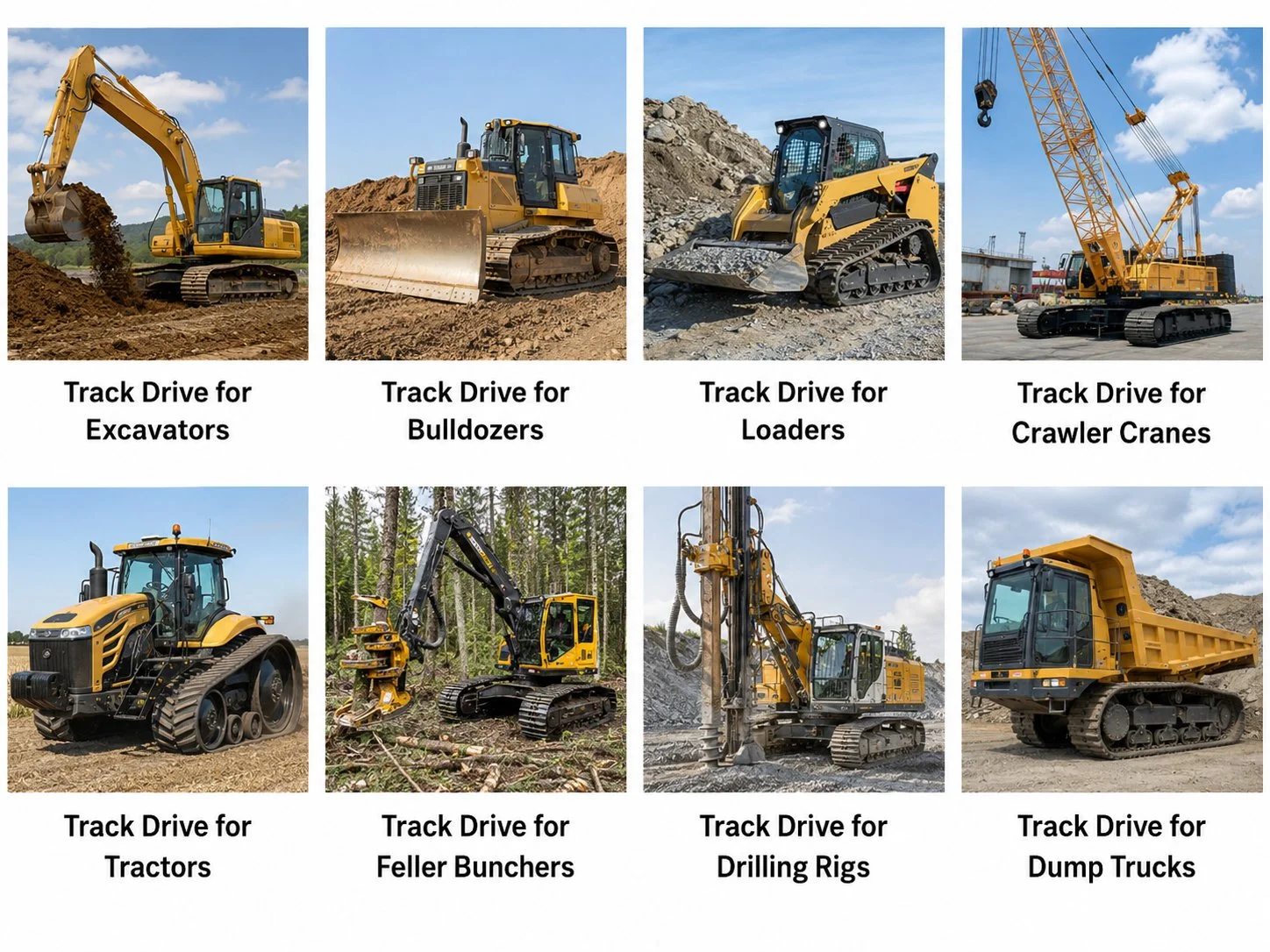
Forestry Seal Engineering — Protecting the Gearbox in an Environment Designed to Destroy Seals
The duo-cone seal on an excavator track drive contends with mud, water, and sand. The duo-cone seal on a feller buncher track drive contends with all of that — plus bark fibres, vine tendrils, resin-coated sawdust, root fragments, and woody debris that wrap around the sprocket and physically prise the seal faces apart. Standard construction-grade seals rated at 6,000 to 8,000 hours on an excavator may last only 2,000 to 3,000 hours in forestry service.
Forestry-rated track drives use duo-cone seals with hardened steel faces and increased spring force — 15 to 25% higher contact pressure than construction-grade seals. An external debris deflector ring (sometimes called a “seal guard” or “bark ring”) is bolted outboard of the seal to physically block fibrous material from reaching the seal faces. This deflector is a wear item — replaced at 1,000 to 2,000 hour intervals — that sacrifices itself to protect the seal.
Standard breather valves allow fine sawdust and resin particles to enter the housing during the cooling phase of each thermal cycle. Forestry-rated track drives use pressurised breather systems that maintain 0.1 to 0.3 bar positive internal pressure — preventing particle ingress during cool-down. The pressurised system adds cost but extends the oil contamination interval from 500 to 750 hours (standard breather) to 1,500 to 2,000 hours in sawdust-heavy environments.
Feller buncher undercarriages are fitted with steel belly pans that protect the track drive housing from direct stump strikes. But lateral impacts from root protrusions and angled stump remnants can still reach the housing flange. Korea Ever-Power planetary gearbox housings for forestry applications use QT700-2 ductile iron (vs QT500-7 for standard construction) — providing 40% higher impact toughness at the housing flange to resist cracking from lateral stump strikes.
Three Failure Modes That Dominate Feller Buncher Track Drive Replacements
Bark fibres, vine material, and woody fragments wrap around the sprocket hub and work their way between the duo-cone seal faces. Once fibrous material bridges the seal gap, it acts as a wick — drawing water and fine particles into the oil bath. Within 200 to 500 hours of debris intrusion, the oil darkens, bearing surfaces corrode, and the track drive noise increases. This is the single most frequent cause of forestry track drive replacement — and the reason why the debris deflector ring and daily sprocket cleaning are the most cost-effective maintenance practices in logging.
Standard QT500-7 ductile iron housings can withstand axial and radial loads from normal tramming. But the forestry environment introduces lateral impacts — the track drive housing strikes a root protrusion or stump remnant as the machine drives over it. These lateral impacts concentrate stress at the housing mounting flange, where the wall thickness transitions from the main housing body to the bolt circle. After hundreds of such impacts, micro-cracks initiate at the flange radius. Over 3,000 to 5,000 hours, the cracks propagate until the housing flange fractures — a catastrophic failure that cannot be repaired in the field.
When a track shoe strikes a stump or large root, the impact generates a radial force at the sprocket hub of 50,000 to 80,000 N — a short-duration shock that the output bearing must absorb without permanent deformation (brinelling). Standard-grade track drive output bearings rated for the static radial capacity of the tramming load (25,000 to 40,000 N) do not carry sufficient C0 (static load rating) margin for the stump-strike peak. Over 10,000 to 30,000 stump strikes per year, the bearing raceway develops brinelling marks — flat spots from impact deformation. These marks produce periodic vibration as the rollers traverse them, accelerating raceway fatigue and eventually leading to spalling.
Track Drive Planetary Gearbox for Feller Bunchers — Frequently Asked Questions
Korea Ever-Power forestry-rated track drive planetary gearboxes — QT700-2 housing, debris deflectors, pressurised breathers, impact-rated output bearings — from 20,000 to 100,000 Nm. Provide your feller buncher model and maximum slope specification for a forestry-rated recommendation.
Redaktor: Cxm